

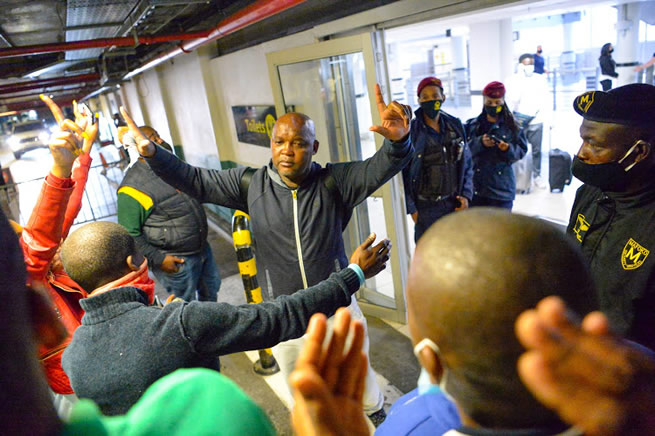
Pitso Mosimane has confirmed that he has held discussions with the South African Football Association about the possibility of taking over as Bafana Bafana coach should Hugo Broos step aside — a development that has intensified speculation around the national team’s succession planning and sparked a tense response from Safa president Danny Jordaan.
Mosimane, one of South Africa’s most decorated coaches and a figure widely regarded as a natural contender for the top national job, said he has spoken with Safa about what a future Bafana plan would look like. His comments came amid uncertainty over Broos’ intentions and the association’s alleged desire to keep the Belgian in place for longer than previously expected.
Broos initially said he would retire after the Fifa World Cup. However, recent reports have suggested Safa may want to extend his stay for another year — claims the association has vehemently denied. Still, the fact that Mosimane has now publicly confirmed talks with Safa has placed the national team coaching debate firmly back on the table.
If Broos does leave, Mosimane is widely seen as the frontrunner to replace him. He has previously coached Bafana Bafana, holding the role from 2010 to 2012, and has since built a trophy-laden career at club level, including major success with Mamelodi Sundowns and Al Ahly. On Monday, at the launch of his Youth Football Coaching Manual in Sandton, Mosimane addressed questions about the national team job and the broader question of how Bafana should evolve from where Broos has taken them.
“Well, the Bafana job … I don’t know when the contract is ending,” he said when quizzed at the launch of his Youth Football Coaching Manual in Sandton.
“Is he available or not? But I know that the federation has spoken to a lot of us about somebody to come in [with a] succession plan. What do you want? What are you going to do? What’s your plan? How do we take Bafana to a better level?”
Mosimane’s remarks suggest that, at minimum, Safa is canvassing ideas for what comes next — either to support Broos with a succession plan or to prepare for the possibility of transition. His emphasis on being asked about a “plan” also indicates that the discussions were not simply informal chat, but involved questions about strategy, development and long-term progression.
His comments come at a moment when Broos’ record has strengthened his standing. Under Broos, Bafana won bronze at the 2023 Africa Cup of Nations and reached the last 32 at the World Cup — achievements that have shifted public expectations and improved confidence in the national team.
Yet Mosimane was not persuaded by the idea that Broos’ accomplishments have placed the bar out of reach. In fact, he argued the opposite: that the standard can be raised further and that no individual should be treated as irreplaceable.
“I always say it’s important to leave the jersey at a better place. There’s room for improvement. I left Sundowns with the Champions League (title); did they have the second one? Yes. I left after winning the treble, and how many league titles have they won since?
“Every stage and every level can be reached, can be improved. It’s not the first time we qualify for the World Cup, right? It’s not the first time we did well at the Afcon. Clive Barker won it in 1996.
“So, we can maybe talk about going into the next round of knockouts. Yes, that we can celebrate. But being in semifinals, quarterfinals (at Afcon), have we done that? Let’s be honest… we can raise the bar, and nobody is indispensable.”
The statement is striking for two reasons. First, Mosimane explicitly placed Broos’ achievements in historical context, noting that South Africa have qualified for the World Cup before and have had high points at Afcon. Second, he pointed to the idea that progress does not stop with one coach — using his own example at Sundowns to argue that clubs and teams can build on success rather than become dependent on a single figure.
His reference to Clive Barker’s 1996 Afcon triumph also carries weight, because it reminds the public that Bafana’s legacy includes a continental title — and that modern achievements, while important, should not become the ceiling.
While Mosimane spoke calmly about improvement and planning, Jordaan’s public reaction to questions about the coaching situation appeared far more combative. Pressed on the issue, Jordaan stormed out, insisting that no decision has been made and denying reports of a one-year contract for Broos.
“No one at Safa has signed a one-year contract with Broos, it doesn’t exist.. There’s a process, the technical team makes a recommendation to the executive, and they decide on the coach.
“You can’t stop me on the street and hijack me over a decision that has not happened. SA must wait,” he said and abruptly ended the interview.
Jordaan’s remarks underline Safa’s insistence on process — and its irritation at being pushed to confirm or deny decisions before the official structures have concluded their work. At the same time, the contrast between Jordaan’s denial and Mosimane’s confirmation of talks has fuelled more questions: if no decision has been made, why has the federation been speaking to “a lot of us” about succession planning? And if Broos is expected to stay until the World Cup, what does a “succession plan” look like in practical terms?
The debate is also shaping up as one of ambition. Broos has delivered results that have restored belief and raised expectations. Mosimane is arguing that those achievements should be seen as a platform, not a peak. Safa, meanwhile, is trying to manage public pressure and media scrutiny while keeping its internal decision-making structures intact.
For supporters, the uncertainty comes with a mix of hope and anxiety: hope that Bafana can consolidate their recent momentum, and anxiety that a poorly managed transition — or an extended period of uncertainty — could unsettle the team.
For Mosimane, the position is clear: he has spoken to Safa, he is aware the federation is sounding out candidates, and he believes Bafana can climb higher.
For Safa, Jordaan’s message is equally blunt: there is no one-year Broos contract, no street-corner “hijacking” of decisions, and the country must wait.