

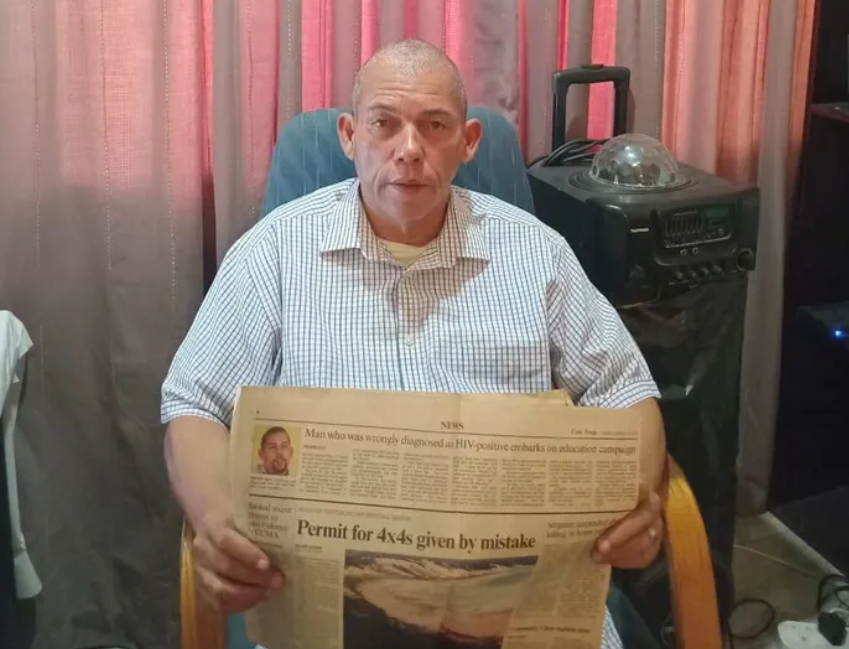
In 2001, Mark Johannes was at the top of his game. Known as "Mr BMW" in the coastal town of George, he was a highly successful car salesman with a thriving career, a beautiful family, and a bright future. But his world was about to be shattered by a single phone call that would turn into a quarter-century of psychological torture. After visiting a dermatologist for a severe skin condition and requesting a "quick" HIV test just to be safe, Johannes received the news that no one ever wants to hear: he was HIV-positive. At the time, with the virus still carrying a massive social stigma and limited treatment options in South Africa, Johannes believed he had just been handed a death sentence.
The impact was immediate and devastating. Convinced that he was going to "die anyway," the once-confident salesman gave up on everything he had worked for. He lost his job at the BMW dealership, his marriage began to crumble under the weight of mistrust and fear, and the people closest to him—including his two young children—slowly drifted away as they prepared for his inevitable demise. "It was one setback after the other," Johannes recalls, describing a period of his life where hope was a luxury he could no longer afford. For four long years, he lived in the shadow of a virus he didn't actually have, waiting for a death that refused to come.
The Herolds Bay Standoff: A Father’s Final Choice
The psychological toll of the diagnosis reached a terrifying peak in 2005. Feeling defeated and broken, Johannes drove to the scenic Herolds Bay with two firearms—a 9mm pistol and a 6.35mm—intending to take his own life. He sat in his car, staring at the ocean, ready to end the "pain and suffering" that had become his daily existence. But in a moment of clarity that would save his life, thoughts of his children flooded his mind. He couldn't bear the thought of them growing up without a father, even one who was "dying." He put the guns away and drove home, unaware that the "final piece of the puzzle" was about to be revealed in the most shocking way possible.
Just weeks after his brush with suicide, Johannes’ doctor called him in for an urgent meeting. The news was not about his health failing, but about a medical miracle that was actually a massive mistake. The doctor admitted that Johannes was, in fact, HIV-negative. In a desperate attempt to explain the unexplainable, the doctor reportedly described it as "spontaneous healing"—a medical impossibility that Johannes now views as the beginning of a massive cover-up. The "Mr BMW" who had lost his career, his family, and his dignity was told to simply go back to his life as if the last four years of terror had never happened.
The Seesaw Of Science: Positive, Negative, Positive
The horror of the misdiagnosis was compounded by a bizarre series of conflicting test results that Johannes describes as a "seesaw." After the initial positive result in 2001, further tests had reportedly come back negative, yet the "positive" label continued to haunt him. The most egregious error occurred later in 2005 when Johannes applied for a life insurance policy. He underwent a third test through his family doctor, and the samples were sent to PathCare Pathology—the very same laboratory that had processed the first two tests. Shockingly, the results came back positive for a third time.
"It was like a seesaw, then I was positive, then negative and then again positive…" Johannes told investigators. The sheer incompetence of a laboratory producing a positive result for a man who was clinically negative is at the heart of his current legal battle. PathCare CEO JW Douglas has since claimed that the company is restricted by POPIA regulations but insists that none of the clinicians or the laboratory were at fault. He has even gone as far as to label Johannes’ recent attempts to get answers as "concerning" and "threatening," a move that Johannes sees as a classic case of victim-blaming by a corporate giant.
Two Decades Of Silence: The HPCSA Cover-Up
For the past 19 years, Mark Johannes has been fighting a wall of bureaucracy and silence. He initially took his complaint to the Health Professions Council of SA (HPCSA), but the body concluded in 2007 that no medical negligence had been committed. Their reasoning? The practitioner was simply "communicating the results from the laboratory." It was a circular argument that left Johannes with no one to hold accountable. He claims that for two decades, he was denied access to vital documentation that would prove the "crime and subsequent cover-up" that destroyed his life.
The breakthrough finally came on 11 May 2026, when Johannes says he received the "final piece of the puzzle" from the HPCSA. Armed with new documentation, he has now filed a formal complaint with the SA Human Rights Commission (SAHRC). He is seeking condonation for the 25-year delay, arguing that the "human rights violations" against him are ongoing because the parties involved continue to deny him justice. The SAHRC has reportedly agreed to take on the case, with Commissioner Chris Nissen confirming the receipt of the complaint. For Johannes, this is not just about money; it’s about a formal acknowledgement that his life was stolen by a laboratory error.
A Life Rebuilt, But The Scars Remain
Today, at 56, Mark Johannes lives in Cape Town, far from the "Mr BMW" glory days of George. He has rebuilt his life, but the emotional scars of being a "dead man walking" for four years have never truly healed. He speaks of the "judgment" and "mistrust" that still lingers in his mind, and the pain of knowing that his children spent their formative years believing their father was dying of a stigmatized disease. His story is a chilling reminder of the power that medical laboratories hold over our lives and the devastating consequences when that power is used negligently.
As the SAHRC begins its investigation, the eyes of the nation are on PathCare and the HPCSA. The case of Mark Johannes is a landmark test for human rights in South Africa, challenging the time limits on justice for victims of medical malpractice. "These people destroyed me," Johannes says, his voice filled with a mix of exhaustion and determination. He is no longer the man with a gun at Herolds Bay; he is a man with a mission to ensure that no other South African has to live through the twenty-five-year nightmare of a false death sentence.