

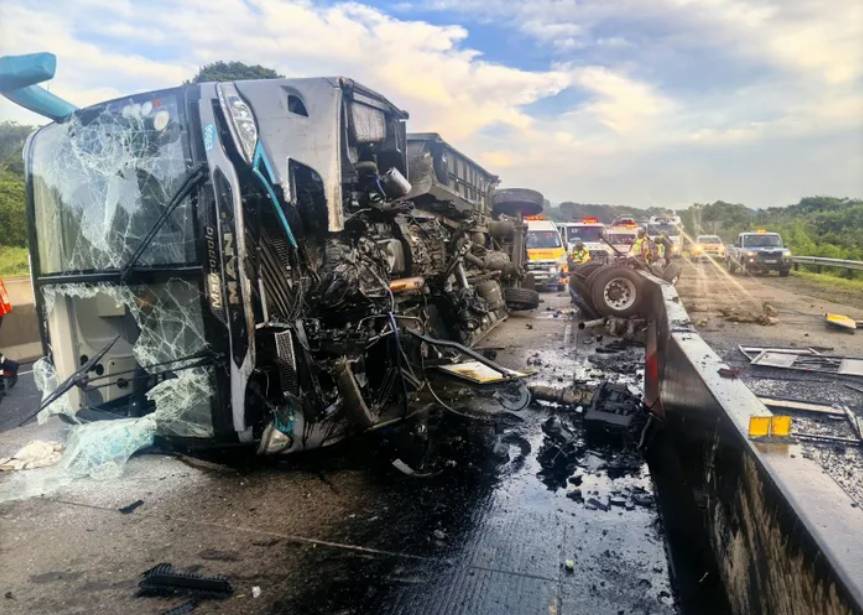
A luxury bus carrying about 28 passengers to Durban overturned on the N3 near New England Road in KwaZulu-Natal on Monday morning, leaving 26 people injured and forcing authorities to close part of the busy route.
The crash happened at about 05:30, when many commuters and long-distance motorists were beginning their journeys. The bus was travelling towards Durban when it lost control and overturned near New England Road.
KwaZulu-Natal transport authorities said the N3 was closed while emergency teams worked at the scene, assisted injured passengers and managed the traffic disruption.
Ndabezinhle Sibiya, spokesperson for the KwaZulu-Natal Department of Transport, urged motorists travelling towards Durban to avoid the crash area and use alternative routes.
“Motorists travelling to Durban are requested to use alternative routes towards Hayfields or Ashburton,” Sibiya said.
Sibiya added that the Road Traffic Inspectorate team was at the scene managing traffic. The closure was necessary to allow emergency workers to reach the overturned bus and to keep other vehicles away from the danger area.
KwaZulu Private Ambulance confirmed that its emergency teams responded to reports of a collision on the N3 near New England Road. When the ambulance crews arrived, they found the bus overturned and began assessing the passengers.
“When ambulance services arrived, they found that a bus had lost control and overturned. Medical teams quickly assessed the scene and found that 26 occupants had sustained injuries ranging from serious to minor,” the service said.
The injured passengers were stabilised at the scene before being transported to various hospitals for further treatment.
“No further information is available,” it said.
The service did not provide the names, ages or nationalities of the passengers. It also did not say how many of the injured people were in a serious condition or whether any of the passengers had suffered life-threatening injuries.
There were no immediate reports of deaths. However, the final outcome of the crash will depend on the condition of those taken to hospital and any further information released by medical authorities.
The number of injured passengers means that emergency crews had to manage a major response. Treating 26 people at one collision scene requires medical teams to assess each person, identify the most serious injuries and decide which hospitals can receive them.
Some passengers were reportedly seriously injured, while others suffered minor injuries. Those with suspected spinal injuries, head injuries, fractures or internal trauma would require careful handling before being moved from the overturned bus.
The condition of the bus and the position in which it came to rest will form part of the investigation. Road traffic officials will need to establish why the driver lost control and whether weather, road conditions, mechanical failure, speed or another factor played a role.
At this stage, authorities have not said what caused the bus to leave the road. No conclusion about responsibility should be drawn before the investigation is complete.
The early-morning timing may also be important. Visibility, fatigue and traffic conditions can affect driving, but none of these factors has been confirmed in this crash. Investigators may examine the driver’s hours behind the wheel, vehicle maintenance records and any available footage from the route.
They may also speak to passengers who are well enough to provide statements. Passengers could help explain what happened immediately before the bus overturned, whether they felt the vehicle swerve or brake suddenly and whether there had been any warning of a problem.
The N3 is one of KwaZulu-Natal’s major transport routes and carries large numbers of cars, trucks and buses between the interior and the coast. A crash involving a full passenger bus can quickly cause serious traffic delays and create additional danger for motorists approaching the scene.
The road closure near New England Road was therefore about more than clearing the wreckage. Emergency workers needed a safe working area while traffic officials redirected vehicles and prevented secondary collisions.
Motorists travelling towards Durban were asked to use routes towards Hayfields or Ashburton. Drivers unfamiliar with the alternatives were urged to follow directions from traffic officers and to avoid stopping near the crash scene to take photographs.
Traffic congestion can become dangerous when drivers slow down to look at an accident, make sudden lane changes or ignore barriers. A closed road should be treated as an emergency zone, especially while ambulances and rescue vehicles are moving in and out.
The crash also raises questions about passenger safety on long-distance buses. Operators are expected to ensure that vehicles are properly maintained and that drivers are fit to operate them. Passengers also need access to working seat belts where they are fitted and should remain seated while the bus is moving.
It has not yet been confirmed whether all the passengers were wearing seat belts or whether the bus was carrying luggage that may have shifted during the rollover. Those details may emerge in the transport investigation.
The number of people on the bus was described as about 28, while 26 occupants were reported injured. Authorities have not yet explained the condition of the remaining passengers. Some may have escaped injury, but an official passenger list and complete medical assessment would be needed to confirm the final numbers.
The bus operator has not been named in the available information. It is also not known whether the trip had started in another province or where the passengers were due to travel after reaching Durban.
Families waiting for relatives may have faced hours of uncertainty while passengers were taken to different hospitals. When a large group is injured, it can be difficult for relatives to immediately establish where each person has been taken.
Hospitals may also have had to activate emergency plans to receive several patients from one crash. Medical teams would have needed to treat different injuries while keeping track of each passenger and updating families as information became available.
The crash happened during a period when the N3 is often busy with commuters, freight vehicles and long-distance travellers. Any closure can affect people travelling to work, school, hospitals and businesses in Pietermaritzburg and Durban.
Traffic officials will now need to clear the overturned bus and inspect the roadway before the route can fully reopen. The exact reopening time was not provided.
Authorities are likely to examine the scene for skid marks, damaged road barriers, broken vehicle parts and other evidence. These details can help show whether the bus braked, swerved or rolled after leaving its lane.
The driver’s condition and possible account will also be important. If the driver is among those injured, investigators may need to wait until medical staff confirm that it is safe for the driver to be interviewed.
Any criminal or traffic charges would depend on the evidence gathered. At present, the confirmed information is that the bus overturned, 26 occupants were injured and the route was closed while emergency services responded.
The accident is a reminder of how quickly a normal journey can turn into a mass-casualty emergency. Passengers travelling together may expect to arrive in Durban within a few hours, but a single loss of control can leave dozens of people needing treatment.
For the injured passengers, the immediate priority is recovery. Some may face long hospital stays, surgery or rehabilitation, depending on the seriousness of their injuries. Others may be discharged after receiving treatment for less serious wounds.
The families of those in hospital will be waiting for updates, while authorities continue to establish what went wrong. Clear information will be important to prevent rumours from spreading about the cause of the crash or the condition of the passengers.
The KwaZulu-Natal Department of Transport and emergency services are expected to provide further information when it becomes available. Until then, motorists are being urged to avoid the affected section of the N3, use alternative routes and obey traffic officials.
The investigation will ultimately need to answer several questions: why did the bus lose control, was there a mechanical or road-related problem, and could the crash have been prevented?
For now, 26 people are receiving medical care after a coach carrying them towards Durban overturned near New England Road. The road has been closed, emergency teams have transported the injured to hospital and traffic authorities are working to restore safe movement on one of KwaZulu-Natal’s key routes.