

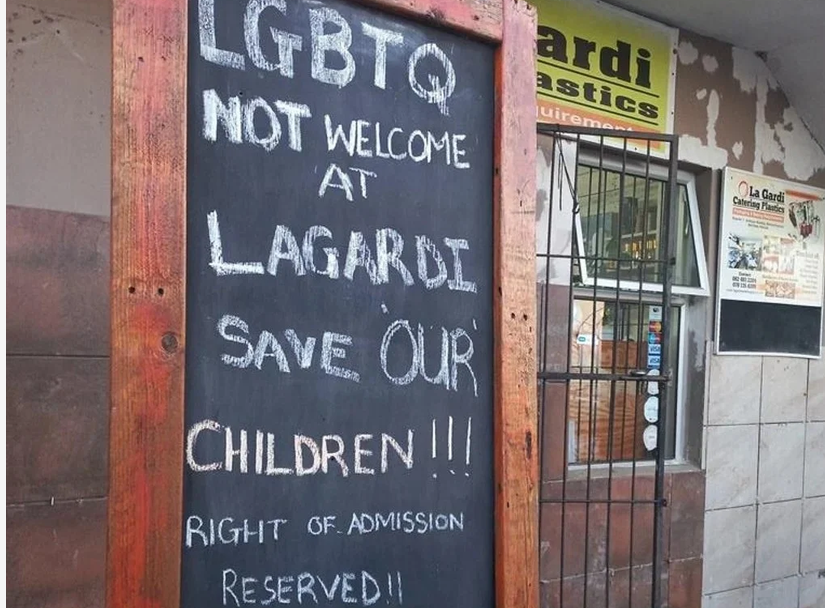
The Equality Court has found that a sign declaring “LGBTQ not welcome at La Gardi – save our children” constituted hate speech, unfair discrimination and harassment.
The sign was displayed outside La Gardi Plastics and Baking Requirements, a Gqeberha business owned by Dawood Lagardien. It was put up in 2023 to prohibit members of the LGBTQIA+ community from entering the shop.

The South African Human Rights Commission brought the matter against Lagardien. The court ordered him to issue a public apology, barred him from engaging in further unlawful conduct and directed him to pay R200,000 in damages to an equality-promoting non-governmental organisation to be identified by the SAHRC.
The matter was also referred to the National Prosecuting Authority for criminal investigation.
The judgment found that the sign infringed the rights to equality and dignity of LGBTQIA+ people. It also considered Lagardien’s creation and administration of a WhatsApp group called “Our Rights – anti LGBTQ+”, which he later deleted.
Sign followed dispute in shop
In court papers, Lagardien described an incident in June 2023 involving two men who had entered his shop. He said the men had “shamelessly” kissed and claimed they were “fondling each other at the groin area of the body in view of all Muslim customers”.
Lagardien said he “politely requested the two males” to leave the premises. He claimed that, while leaving, the men told him it was Pride Month and that “we can do as we please”.
He argued that the sign was not a threat to members of the LGBTQIA+ community and maintained that people entering his business had an obligation to respect the rights of others.
The Equality Court rejected that position and found that the display amounted to unlawful discrimination, harassment and hate speech. The court’s finding means that a business owner’s religious or personal views cannot be used to justify publicly excluding a protected group or attacking its dignity.
The sign was later removed and the WhatsApp group discontinued. The court nevertheless proceeded with the matter and granted remedies, finding that the removal of the sign did not make the case irrelevant.
Activist welcomes judgment
Human-rights activist Sikhander Coopoo, who is queer and Muslim, welcomed the judgment. Coopoo said the sign had made people like him feel unsafe and unwelcome in a public commercial space.
“As a human rights defender who also happens to be queer and Muslim, I welcome it with my whole body, because my body does not feel safe. When that sign went up in Gqeberha, it said people like me were not welcome,” Coopoo said.
He said the judgment affirmed the rights of LGBTQIA+ people and had significance beyond the immediate dispute.
“This is not just a legal win for people like me. It is the state saying, through its courts, that our dignity is real.
“This judgment is not only about LGBTQIA+ people. If Mr Lagardien had won, any shop, gym or church could put up a sign saying no women, no Muslims, no Christians, no disabled people. We continue to be threatened but will not be silenced.”
Coopoo said the judgment sent a message that discrimination in public spaces would not be protected merely because it was presented as a matter of religious belief or personal conviction.
SAHRC says ruling reinforces constitutional rights
The SAHRC described the judgment as significant and said it clarified the relationship between freedom of religion, freedom of expression and the rights to equality and dignity.
“First, it reaffirms that the constitutional rights to freedom of religion and freedom of expression, while fundamental, do not justify conduct that unlawfully infringes others’ dignity and equality,” said the SAHRC’s Eastern Cape manager, Eileen Carter.
Carter said the court had also recognised that discriminatory conduct could take place both in physical spaces and through digital communications.
“In considering the respondent’s establishment and administration of a WhatsApp group, the court demonstrates how existing human rights protections apply to harmful conduct facilitated through digital platforms,” she said.
The commission also welcomed the court’s decision to hear the matter even though the sign had been removed and the WhatsApp group discontinued.
“Third, the court rejected the argument that the matter had become moot simply because the offending sign had been removed and the WhatsApp group discontinued. This reinforces the importance of accountability and effective remedies, including where the immediate offending conduct has ceased.”
Carter said the ruling acknowledged the harm caused by targeting historically marginalised communities.
“The protection of equality and dignity remains a constitutional imperative, irrespective of an individual’s sexual orientation or gender identity. The commission remains committed to challenging unfair discrimination, harassment and hate speech, and to promoting a society founded on human dignity, equality and freedom for all,” she added.
Criminal investigation referred to NPA
The Equality Court’s referral to the National Prosecuting Authority means that a separate criminal investigation may now follow. The referral does not itself amount to a criminal conviction or establish that criminal charges will be brought.
The NPA will have to assess the available evidence and determine whether the conduct meets the requirements of any applicable criminal offence. The Equality Court proceedings dealt with the alleged discriminatory conduct and the remedies arising from it.
Lagardien has been interdicted from engaging in further unlawful conduct. He must also issue the court-ordered public apology and pay the damages to an organisation selected by the SAHRC.
The judgment underscores that businesses open to the public remain subject to constitutional protections and equality legislation. It also highlights that discriminatory messages shared online may be considered alongside conduct occurring in a physical business premises.
The ruling does not prevent people from holding religious beliefs or expressing views. It establishes that those freedoms do not extend to conduct that unlawfully demeans, excludes or harasses members of a protected community.