

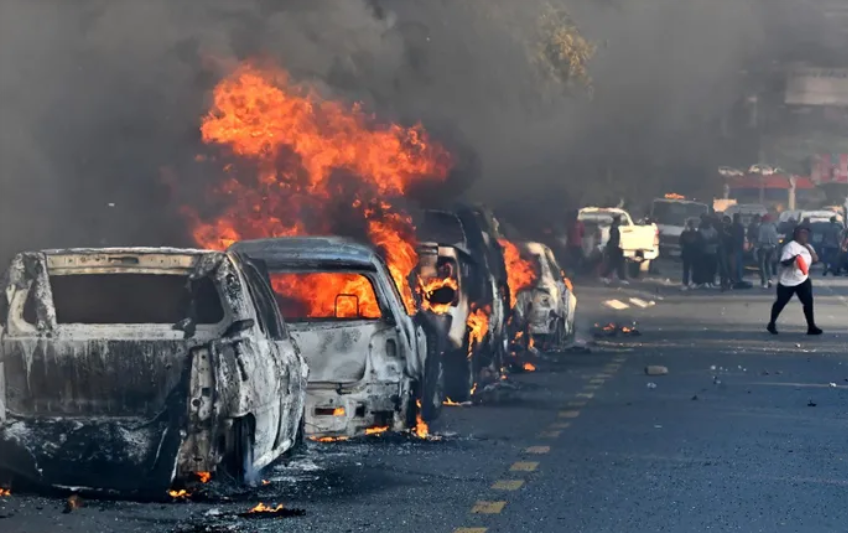
Chaos and looting erupted in Durban on Friday night as police struggled to keep control of fast-moving crowds protesting over the government’s handling of asylum applications.
KwaZulu-Natal Premier Thami Ntuli called for the deployment of the South African National Defence Force, saying the situation warranted additional support to protect residents, businesses and public infrastructure.
The unrest followed protests linked to a Constitutional Court judgment on access to South Africa’s asylum system and the Home Affairs directive that was issued to give effect to the ruling.
The directive was later withdrawn after refugee reception offices were overwhelmed and the department raised concerns about the safety of officials and public order.
Although the protests were initially framed around immigration and asylum policy, events in Durban escalated into looting, arson and damage to property.
The police response was complicated by crowds splitting into different groups and moving rapidly through the Durban central business district.
Dozens of police vehicles were deployed in the streets as officers attempted to follow the groups and prevent further damage.

Ntuli said he had appealed to Police Minister Firoz Cachalia to deploy the army in KwaZulu-Natal.
“I have already spoken to the police minister to say that the situation warrants the deployment of the SANDF in KwaZulu-Natal. I think they are processing my request,” Ntuli said.
The premier spoke against a backdrop of disorder in the Durban CBD, where police were attempting to contain crowds while also responding to reports of vehicles being burned and shops being looted.
About 14 vehicles were reportedly set alight in Durban, while shops were looted and a building was torched.
The number of damaged vehicles formed part of a wider total of roughly 24 vehicles reportedly burned in Durban and Soweto during the unrest.
The full extent of the damage, injuries and arrests was still being assessed as authorities worked through the scenes.
Ntuli acknowledged that the authorities had been caught off guard.
He said officials had believed that the situation would remain manageable after violence and vehicle fires were reported earlier in the week.
“The situation is unfortunate. Yesterday, we saw cars burnt, and we thought that this afternoon things would be calm. We thought the police were attending to that and that we had the capacity to handle whatever would come along,” he said.
The premier said some people were using public frustration and the Constitutional Court judgment as a cover for criminal activity.
“I do realise [now] that there are people who are using the frustrations of people and the judgment of the Constitutional Court to commit crime,” he said.
Ntuli warned that the destruction would harm the same communities that protesters claimed to be defending.
“We need to protect the lives of people from KZN and those not from KZN and not destroy opportunities where people lose jobs,” he said.
The premier said the government was planning to re-engage leaders in an effort to calm the situation, similar to discussions held before the protests of 30 June.
“Things did not happen like they did pre-30 June, according to the information we were able to receive. We need to engage the leaders – we know some of them – and we see some faces that are different,” Ntuli said.
He urged people to consider the long-term consequences of the destruction.
“Let’s protect KwaZulu-Natal. When we destroy today, the pain will be felt tomorrow,” he said.
The comments reflected the government’s attempt to distinguish between legitimate concerns about immigration policy and criminal behaviour such as looting, arson, assault and destruction of property.
Government spokesperson William Baloyi also appealed to people not to commit crimes while raising what he described as genuine grievances.
Baloyi said the Interministerial Committee was urgently considering how to implement the Constitutional Court order without creating further harm.
“The judgment has had unintended consequences. We are seized with the issue of seeing how implementation can be done without compromising the safety and security of the nation,” he said.
But he said the government could not simply ignore the court order.
“We don’t want to create a situation where we are in contempt of court, so it is not an easy situation,” Baloyi said.
The Constitutional Court judgment requires asylum seekers to be allowed access to the formal determination process even where certain procedural or technical requirements have not been met.
It does not grant refugee status automatically, create a blanket amnesty for undocumented migrants or provide automatic permanent residence.
The government has said misinformation about the judgment contributed to the protests and helped fuel anger in communities already frustrated by unemployment, access to services, crime and competition for economic opportunities.
Baloyi urged protesters to stop committing offences.
“We call on the people not to commit further crimes while they raise genuine grievances because once you get into issues like looting and are involved in criminal activities, you are not helping the situation, you are worsening the situation,” he said.
He warned that the destruction could damage businesses and public facilities that support the country’s economy.
“You are destroying the same property that is assisting this country and creating a situation where you will have a criminal record, which is not good for your future,” he said.
The violence was reportedly fuelled in part by social media posts, including material that authorities said was false or misleading.
Images and videos of burning vehicles and crowds moving through the streets circulated rapidly, making it difficult to establish which incidents were current, where they had occurred or whether some footage came from earlier protests.
The spread of unverified information can intensify panic and encourage people to join crowds without understanding the circumstances on the ground.
It can also make it harder for emergency services and police to identify the most urgent threats.
Authorities faced a difficult public-order operation because the crowds were not moving as one group.
Protesters split into smaller groups, moved through different parts of the city and targeted businesses and vehicles.
That required police to divide their resources while trying to protect people, control roads and prevent the unrest from spreading.
The request for SANDF assistance will now have to be considered through the relevant government and security processes.
Any military deployment in support of the police would have to operate within the law and under clearly defined instructions.
The SANDF has previously been deployed to assist with public-order and security operations, but the responsibility for policing protests and investigating crimes generally remains with the South African Police Service.
The premier’s request came as political authorities again faced criticism for being caught off guard by the scale and speed of the unrest.
Ntuli said that earlier engagement with prominent Zulu leaders, including discussions involving President Cyril Ramaphosa, had helped avert chaos before the anticipated 30 June protests.
He indicated that similar engagement would now be necessary to identify legitimate leaders, separate them from people exploiting the protests and establish a path towards calm.
The government will also need to explain how the withdrawn Home Affairs directive will be replaced.
The department said the directive had been withdrawn because refugee reception offices became overwhelmed, officials faced safety risks and serious public-order concerns emerged.
However, the Constitutional Court order remains binding.
That leaves officials with the task of finding a system that allows asylum applications to be received and assessed while ensuring that offices are secure and operationally sustainable.
The unresolved administrative issue may continue to drive public anxiety if communities do not receive clear information about what the judgment means.
The government has insisted that asylum seekers are not automatically granted refugee status and that immigration enforcement has not been abandoned.
At the same time, the state cannot prevent someone from entering the asylum determination process solely because of technical or procedural problems that the court found constitutionally invalid.
That legal distinction has been difficult to communicate during a rapidly changing political and security situation.
In Durban, the immediate priority is restoring order, protecting residents and businesses and preventing further attacks.
Authorities will also have to investigate the burning of vehicles, the reported looting, the alleged torching of a building and any assaults committed during the unrest.
People whose property was damaged may need to provide statements, while CCTV footage and social-media material could assist investigators in identifying suspects.
Police will also need to establish whether the incidents were coordinated or whether separate groups acted independently after being drawn into the same protest atmosphere.
The unrest has threatened both migrant-owned and South African-owned businesses, while residents and workers have been exposed to danger in the CBD.
The destruction of shops and vehicles also risks causing job losses and further economic hardship in areas already struggling with unemployment.
Ntuli’s warning that the pain would be felt tomorrow reflected the long-term consequences of violent protest.
Businesses may close, insurance costs may rise, public facilities may be damaged and communities may lose access to essential services.
The government has appealed for calm, but the events in Durban show that public anger remains high.
The challenge now is to address genuine concerns about immigration and asylum policy without allowing those concerns to become a justification for looting, arson, assault or attacks on foreign nationals.
For the moment, police remain responsible for containing the unrest while authorities consider the request for military support and the government works on a new approach to implementing the Constitutional Court judgment.
The streets of Durban will remain under close watch as officials try to prevent another night of violence and rebuild confidence in the city’s public-order response.