

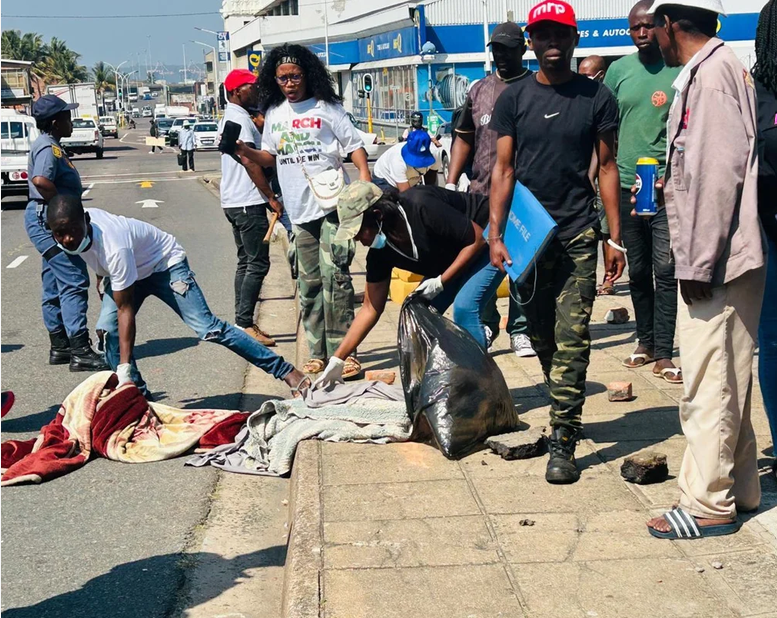
A planned clean-up operation outside Durban’s Home Affairs offices descended into a tense confrontation on Thursday, forcing police to fire tear gas and rubber bullets as protesters and refugees faced off along Che Guevara Road in Umbilo.
A foreign national was arrested after allegedly throwing a stone that struck a police officer, while several people were reportedly injured during the confrontation.
The clash followed weeks of growing frustration among businesses and residents over a makeshift camp that has occupied pavements outside the Department of Home Affairs Refugee Reception Centre for about 15 weeks.
The camp is home to more than 450 Congolese refugees and asylum seekers who say they have nowhere safe to go.
About 100 supporters of anti-immigration group March and March arrived at the site on Thursday, saying they wanted to clean the area and draw attention to the continued occupation of public spaces.
Police had been deployed because of fears that the demonstration could bring protesters into direct conflict with people living at the camp.
The situation deteriorated when protesters allegedly began removing essential belongings belonging to the refugees.
KwaZulu-Natal police spokesperson Colonel Robert Netshiunda said a physical confrontation then broke out between the groups.
“About 100 marchers went on what they termed a clean-up campaign, during which they allegedly picked up essential belongings belonging to foreign nationals. A physical confrontation then erupted,” Netshiunda said.
Police moved in to separate the groups and used tear gas and rubber bullets to restore order.
Netshiunda said officers were also registering a case against a foreign national accused of assaulting a police officer with a stone during the confrontation.
He said police used “minimum crowd-management proportional force” while dealing with the unrest.
The arrest came as emotions ran high around a camp that has become one of Durban’s most visible flashpoints in the country’s continuing immigration debate.
The makeshift settlement stretches along the pavements near the Home Affairs offices, with tents, blankets, bedding and personal possessions lining parts of the roadside.
The refugees have remained there since leaving communities where they had previously lived.
Many say they fled after facing threats linked to anti-foreigner sentiment and calls by anti-immigration groups for undocumented immigrants to leave South Africa by 30 June.
The deadline was not a government order, but it created uncertainty for people who feared returning to the areas where they had been staying.
The refugees have also rejected demands that they return to the Democratic Republic of Congo, saying some do not feel safe going back there or to the South African communities they previously called home.
Businesses Say The Camp Is Driving Customers Away

Business owners in the area say the prolonged presence of the camp has affected their ability to operate normally.
They complain about congestion, noise, litter and sanitation problems around their businesses and nearby buildings.
One business owner said the situation had become unbearable and that customers were avoiding the area.
“As you can see, the whole road is filthy, and the situation is unbearable. We are losing business, and we cannot function like this. Customers now fear even coming close to the area because of the situation, and it has been ongoing for months,” he said.
Another business owner said the conditions were also affecting accommodation establishments in the area.
The owner said tenants had complained about noise and the environment around their buildings. Some of the tenants were students who were struggling to study during the day and sleep at night.
“My tenants are complaining that they cannot deal with the unhygienic smell around them. My tenants, many of whom are students, have also decided to leave the area because they cannot study well during the day and also sleep at night,” said the building owner.
Residents raised similar concerns, saying the number of people living along the road had increased and that the situation had disrupted their daily lives.
Sanitation has become one of the central complaints. Residents claimed that some people at the camp used pavements, bins and buckets when they needed to relieve themselves.
They also complained about noise during the day and at night.
For surrounding businesses and residents, the argument is not simply about whether the refugees should be allowed to remain outside Home Affairs. They say a public space has become a long-term settlement without adequate sanitation or a clear plan for what happens next.
One resident said: “We understand that these people have problems and that they need assistance, but this situation is affecting everyone around here.”
Refugee Leaders Reject The Claims

The Congolese community has rejected suggestions that it is responsible for making the area unsafe or dirty.
Community leader Bishop Raphael Bahebwa said refugees regularly cleaned the streets and maintained the area around the camp.
“For us, we are always cleaning the streets. We are always maintaining the streets. We are not a danger to anyone. We don’t attack anyone, and we don’t pose any violence or threats to anyone,” said Bahebwa.
He also disputed claims that the camp was filthy, saying the refugees had tried to keep their surroundings clean during the weeks they had been there.
Bahebwa said the refugees believed they had been taken to the Home Affairs office by the municipality and would remain there until the government provided them with somewhere safe to stay.
He said they had been offered the choice of returning to the communities where they had lived or being moved elsewhere, but that they did not believe either option would protect them.
“We hear the complaints from the local businesses, but for us, we do not dirty the place. We are clean. We make sure that we clean the area and we do not commit any crime,” he said.
His comments highlighted the deep divide between the people living at the camp and those affected by its presence.
The refugees say they are seeking safety and a solution. Businesses and residents say they are bearing the cost of an arrangement that was never meant to last for months.
Municipality Disputes Refugees’ Account
The eThekwini Municipality has disputed the claim that it placed the refugees outside the Home Affairs offices.
Mayoral spokesperson Mluleki Mntungwa said Mayor Cyril Xaba had facilitated transport to Home Affairs so that the refugees could be verified.
Mntungwa said the refugees were found to be legally documented after the verification process.
He said they were then given two options: to return to the communities where they had previously been staying or to move to the Lindela Repatriation Centre.
“They were totally cleared and given options, but they never took any of the options,” said Mntungwa.
He said the mayor expected the refugees to return to their respective communities and that the continued occupation of the pavement could not continue indefinitely.
“The law needs to be enforced, and that’s it,” Mntungwa said.
The municipality’s position adds another layer to the dispute. The refugees say they were brought to Home Affairs and left there while waiting for government assistance. The municipality says it transported them for verification and offered alternatives, but that they declined them.
The disagreement has left the camp in limbo, with no clear public announcement about a permanent shelter, an alternative site or a process for assisting those who say they cannot safely return to their previous homes.
A Crisis Built Around A Deadline
The confrontation also reflects the consequences of the 30 June deadline issued by anti-immigration groups.
In the weeks before that date, many foreign nationals left communities where they had been living amid fear of possible attacks or forced removals.
Some were undocumented, while others said they had valid papers or were waiting for their asylum claims to be processed.
The presence of the camp has since become a symbol of a wider dispute over immigration, documentation, housing and public safety.
March and March has demanded that undocumented migrants leave the country, while refugee leaders say broad calls against foreign nationals have made their communities vulnerable.
The clash on Che Guevara Road showed how quickly a dispute about sanitation and public space can become a confrontation involving accusations, property removal and police action.
It also placed police officers in the difficult position of separating two groups with competing grievances while trying to prevent the situation from spreading into surrounding streets.
For businesses and residents, the immediate demand is intervention. They want the camp cleared or relocated and are calling for sanitation and security measures while a longer-term solution is found.
For the refugees, returning to their former communities is not a simple option. They say they fled because they feared for their safety and do not want to be forced into places they believe may expose them to further threats.
The municipality says the refugees were given choices. The refugees say those choices did not provide the safety they needed.
The arrest of the foreign national accused of throwing the stone is now part of the police investigation, while the broader confrontation remains under scrutiny.
March and March had not publicly responded to the allegations that protesters removed belongings from the camp at the time of publication.
The continuing dispute leaves Durban with a problem that cannot be solved through one protest or one police intervention.
The camp has remained outside Home Affairs for months, while businesses, residents and refugees wait for authorities to decide what happens next.
Until that decision is made, the roadside settlement will remain a flashpoint where concerns over immigration, safety, sanitation and human dignity collide.