

The Special Tribunal has ordered architect Minenhle Makhanya to pay R147.2 million to the National Treasury over unlawful conduct linked to the security upgrades at former president Jacob Zuma’s Nkandla residence.
Makhanya was the architect and principal agent responsible for the controversial upgrades at Zuma’s private home in KwaZulu-Natal.
The Special Investigating Unit said the amount represents the financial loss suffered by the Department of Public Works as a result of unlawful conduct during the project.
The judgment was delivered on Wednesday.
The tribunal found that Makhanya’s appointment and conduct in the Nkandla upgrades were unlawful and caused significant financial loss to the state.
Makhanya, who was Zuma’s private architect, became a central figure in the Nkandla scandal after the Department of Public Works appointed him as principal agent for the project without a public tender process.
In the 2014 Public Protector’s report on the Nkandla upgrades, it was noted that the project changed significantly after Makhanya was brought in.
At the time, he had already been involved in Zuma’s non-security construction works.
He was then appointed to act as the department’s principal agent for the entire project while still retaining his position as Zuma’s principal agent and architect.
According to the Public Protector’s report, this was the period when the scale of work increased dramatically and costs escalated to more than R215 million.
“This is the period when the scale of work increased exponentially, leading to installations that were not recommended in any of the authorising instruments … and the cost of works escalating to over R215m,” the report said.
The SIU was authorised to investigate the Nkandla security upgrades under Proclamation R59 of 2013.
Its investigation found that after Makhanya’s appointment, he authorised and oversaw improvements that went beyond the security measures identified by the SAPS and SANDF.
The SIU said this resulted in the cost of the project increasing from R27.9 million to R216 million.
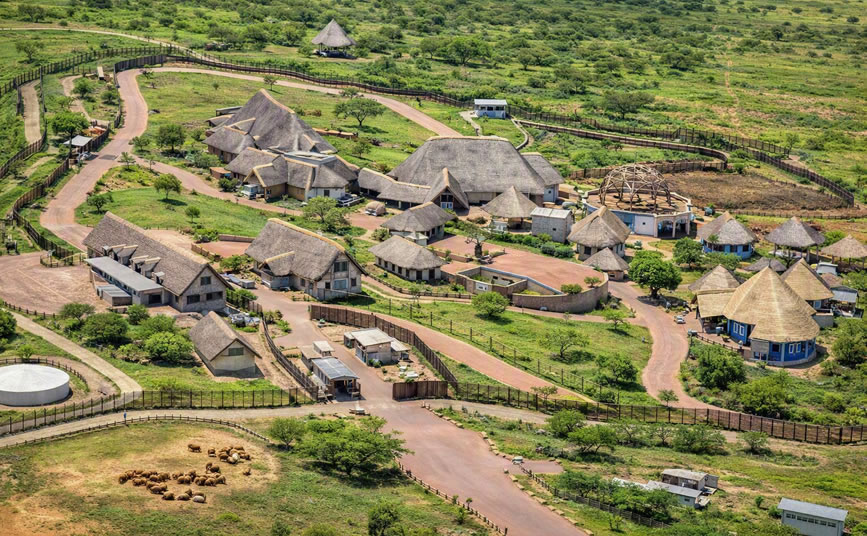
SIU spokesperson Selby Makgatho said the works authorised by Makhanya included tunnels with an exit and three lifts, 20 additional accommodation units for SAPS and SANDF members, a laundry facility, visitors’ lounge, basement parking for the clinic, VIP parking, a “fire pool”, relocation of four households, internal roads, air conditioning and extensive landscaping in the high-security area.
These works amounted to R68.5 million.
Former president Jacob Zuma previously paid R7.8 million for non-security upgrades at his residence, which included the swimming pool and amphitheatre.
The SIU accepted Makhanya’s submission that the R7.8 million repaid by Zuma should be deducted from the total amount.
As a result, that amount will be deducted from the total deemed just and equitable for repayment by the tribunal.
The Special Tribunal also rejected Makhanya’s arguments relating to prescription of the claims.
In addition to ordering him to pay R147.2 million, the tribunal ordered Makhanya to pay the legal costs of the proceedings.
The ruling marks a significant development in the long-running Nkandla matter, which became one of the defining public spending scandals of Zuma’s presidency.
The Nkandla upgrades drew widespread public scrutiny after it emerged that state funds had been used for extensive works at Zuma’s private residence, some of which were later found not to be security-related.
The latest judgment places personal financial accountability on Makhanya for his role in the project.
According to the SIU, the order is aimed at recovering money lost by the state through unlawful conduct in the implementation of the upgrades.
The matter also reinforces the tribunal’s role in dealing with civil recovery proceedings arising from SIU investigations.
For the SIU, the judgment is a further step in recovering public funds linked to irregular state expenditure.
Makhanya is now liable to repay R147.2 million to the National Treasury, with Zuma’s previous R7.8 million repayment taken into account separately.