

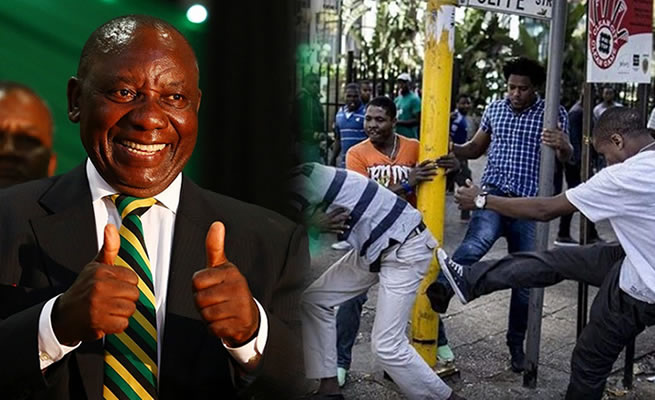
CAPE TOWN – President Cyril Ramaphosa says the government is investigating possible attempts by forces outside South Africa to influence and instigate some of the violence directed at foreign nationals.
The President made the remarks while responding to questions from EFF leader Julius Malema and DA MP Ryan Smith during oral questions in the National Assembly. Ramaphosa did not name any alleged foreign actor, country, organisation or individual. He also did not provide details of the evidence being examined by the police and security authorities.
His statement comes as government faces growing pressure to act against people accused of targeting foreign nationals, disrupting businesses and promoting unlawful action against migrants. Ramaphosa said the state was pursuing both those involved in violence inside South Africa and any possible outside actors linked to efforts to create instability.
He said the government was “deciphering precisely the various roles” played by South Africans and outsiders who wanted to destabilise the country by creating conflict between South Africans and Africans from other countries.
Ramaphosa said African governments had recognised that “quite a bit” of the activity, although “certainly not all of it”, appeared to be propelled and instigated from outside South Africa.
The allegation remains under investigation. The President did not indicate who the outside forces might be, how they were allegedly operating, or when government would be ready to present its evidence publicly. His office has confirmed only that police and prosecuting authorities are following up on criminal activity and possible destabilisation efforts.
Malema pressed Ramaphosa on why people accused of instigating violence and attacks against foreign nationals had not yet been arrested and prosecuted. The EFF leader argued that a failure to act could create an impression that the violence was being tolerated or supported by the state.
Ramaphosa said the police and the country’s security structures were collecting reports, gathering evidence and pursuing those believed to be involved. He said arrests had already been made in related cases and that people suspected of leading violence were of direct interest to the police.
“A number of other people have been arrested,” he said, adding that people believed to be leading the violence were also “of direct interest” to police.
The President said those found responsible for violence against foreign nationals would be pursued and charged. However, he declined to give Malema a deadline for further arrests or prosecutions.
“I do not really like to give” a timeline, Ramaphosa said, arguing that progress would depend on the speed and determination of the police and prosecuting authorities.
The exchange placed the government’s response to anti-migrant action under the spotlight. Ramaphosa said his administration had publicly rejected xenophobia, Afrophobia, vigilantism and discrimination against people from other countries. He said migration management had to be handled through the rule of law, respect for human dignity and stronger state institutions.
Malema’s original question focused on whether violence and hostility directed at Africans from other countries had weakened South Africa’s standing on the continent. He also asked about diplomatic efforts by international relations and co-operation minister Ronald Lamola.
Ramaphosa rejected the suggestion that the country’s position in Africa had been seriously damaged. He said South Africa remained a “respected member” of the African community of nations and a “principled Pan-African actor”.
The President said the government had reinforced its Pan-African commitment through work with the Southern African Development Community, the African Union and partner states on migration, governance and regional integration. He said discussions with other African leaders had shown that they understood the difficulties South Africa was facing and were willing to assist.
Lamola, Ramaphosa said, had been well received during engagements in Ghana and elsewhere on the continent.
“While other people might afford that they are being snapped, and we are being isolated, actually the contrary has been the case,” Ramaphosa said.
South Africa recently used regional engagements, including the SADC summit hosted in eThekwini, to place migration and related tensions on the agenda. Ramaphosa said the regional approach was focused on co-ordinated dialogue and lasting solutions rather than unilateral action.
Smith challenged the President on whether South Africa should do more to confront authoritarianism and democratic decline in neighbouring countries, arguing that political and economic conditions in the region contributed to migration into South Africa.
Ramaphosa said migration was driven by several factors. He referred to people seeking economic opportunity, those fleeing danger and refugees searching for safety. He said South Africa was viewed by many as an “economic oasis”, and that this perception contributed to the movement of people into the country.
The President defended the principle of state sovereignty and said South Africa would work through regional institutions rather than attempt to act alone in neighbouring states. He referred to past regional responses to challenges in Eswatini, Mozambique, the Democratic Republic of Congo, Zimbabwe and Madagascar.
“We are not lone rangers,” he said. “We belong to a community of nations.”
The government’s position is that migration must be managed more effectively inside South Africa. Ramaphosa said the state was working to ensure that people in the country were properly documented and that employers who use undocumented labour were dealt with under the law.
He said the planned reform and modernisation of the migration governance framework included strengthening border management, addressing corruption in the immigration system, improving legal migration pathways and implementing the white paper on citizenship, immigration and refugee protection.
The President’s remarks signal that government is treating the recent violence as both a policing concern and a matter with possible regional consequences. Police are expected to continue investigating people accused of attacks or unlawful mobilisation, while the security authorities examine the President’s claim of possible outside involvement.
For now, the identities of any alleged external actors remain unknown. Government has made clear that it is not saying every incident of violence against foreign nationals is being driven from outside South Africa. Ramaphosa said only that authorities were investigating whether some activity may have been instigated or influenced by people beyond the country’s borders.
The next test will be whether the investigations produce arrests, charges or evidence that can be presented in court. Until then, the government’s stated focus remains on enforcing the law, protecting people from violence and working with regional partners on the broader drivers of migration.