

A motorist who says he witnessed a mob assault near Cape Town’s N7 highway has accused a 10111 operator of refusing to dispatch help and ending his call while the violence was still unfolding.
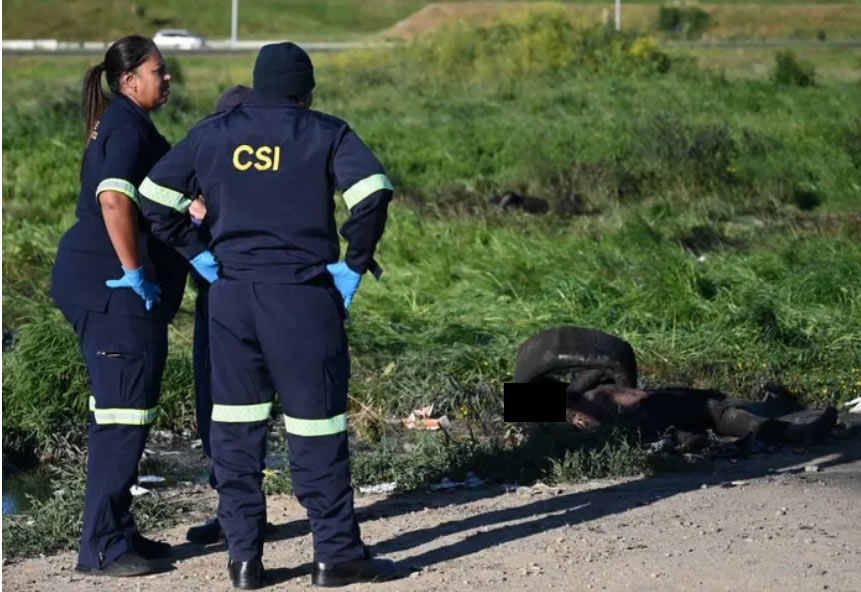
Hours later, four unidentified people were found dead in an open field near the Dunoon off-ramp on Malibongwe Drive.
The witness, Ran Neuner, says he saw several people with their hands tied behind their backs being beaten beside a fire at about 13:00 on Sunday.
He was driving with his two children towards the Durbanville area when they noticed a large crowd gathering near the road.
Neuner says he called the police emergency number because he believed he was witnessing a murder in progress.
He alleges that the operator repeatedly demanded an exact address, told him she could not help without one and ended the call after he asked for her name and badge number.
Police have since opened an internal disciplinary investigation into the handling of the call.
The four deaths are being investigated separately by detectives from the Serious Violent Crime Unit.
The police investigation has not yet established the victims’ identities, the motive for the attack or every detail of what happened at the field.
Family Fishing Trip Turns Into Horror
Neuner was travelling with his children for an afternoon of fishing when his son drew his attention to a fire near the N7.
“My son said, ‘Look, Dad, there’s a fire there’,” he recalled.
At first, Neuner thought the crowd might be attending an event.
But when his vehicle stopped at a traffic light near the off-ramp, he says he was able to see what was happening more clearly.
He opened his window and asked a woman nearby why so many people had gathered.
“Those people stole,” she told him.
That statement was an allegation made by a person at the scene. Police have not confirmed that the victims committed theft or any other crime.
No accusation could justify an assault or killing, and no person may be punished by a crowd without due legal process.
Neuner says he then saw people with their hands tied behind their backs being assaulted with sticks.
“They were being beaten all over their bodies with sticks, with the purpose of killing them. Then just before the robot changed, I saw that people were trying to push the seated men into the fire,” he said.
This remains Neuner’s eyewitness account. Detectives must still compare it with forensic evidence, other witness statements and any available footage.
‘The Scariest, Most Horrific Thing’
Neuner says the size and movement of the crowd made him fear for his own safety and that of his children.
According to him, hundreds of people appeared to be moving from the settlement towards the fire.
He drove through the red traffic light to leave the area.
“You don’t want to be caught in the middle of this,” he said. “It was the scariest, most horrific thing I’ve ever seen.”
His children were in the vehicle and also witnessed parts of the incident.
Neuner later said the experience had affected them and left him thinking about what might have happened if his family had been attacked.
The presence of children added urgency to his decision to leave rather than remain at the roadside.
Once he believed he was at a safe distance, he called 10111 and tried to explain where the assault was taking place.
Desperate Call For Help
Neuner says he told the emergency operator that a serious attack was under way near the Dunoon off-ramp.
He did not have an exact street address because he was not familiar with the area, but he says he gave the street name, the highway reference and his approximate GPS position.
“I said to her, ‘Look, I can’t give you a specific address’.
“I gave her the name of the street. And she said to me, ‘No, but I need to know exactly which highway’,” he said.
Neuner says he again tried to explain that he was not from the area and could only provide an approximate location.
“I said, ‘Look, I’m not from here. I don’t live on this side. I can tell you more or less where it is’. And she says, ‘Well, then I can’t help you’.”
He says he stressed that he was not reporting a minor offence.
“I told her that she wasn’t helping me or the situation at all. I’m busy phoning to report a murder that’s taking place right now,” he said he told her.
According to Neuner, the operator remained unwilling to assist.
When he asked for her name and badge number, he says the call ended.
“She just put down the phone, just like that,” he said.
The operator’s account has not been made public, and the circumstances of the call are now the subject of an internal police investigation.
Four Bodies Found Hours Later
At about 18:00 on Sunday, Western Cape police appealed for information about the murder of four people whose bodies had been found metres apart in the open field.
Milnerton officers had responded to the scene near the N7 off-ramp on Malibongwe Drive.
Police spokesperson Sergeant Wesley Twigg said: “The bodies were burnt beyond recognition.”
Crime-scene observations indicated that tyres had been used to set the victims alight.
Police have not confirmed precisely how the tyres were used, whether the victims died before or during the fire or whether the attack happened exactly as Neuner described it.
Post-mortem examinations and forensic work will be needed to determine the causes and circumstances of the deaths.
The four victims had not been formally identified at the time of the latest update.
Police have also not confirmed a motive, including whether the killings were an act of vigilantism.
Witness Returns To The Scene
Neuner and his children continued with their planned fishing trip after leaving the area.
When they later drove back, police officers and emergency personnel were at the scene.
Neuner says he recognised the location and believed the bodies were those of the same people he had seen being assaulted earlier.
“When I got back to the scene, I just saw the bodies, just charred. The same men who had been tied up were the ones lying there in what I can only imagine was an unimaginable kind of torment. It was the most terrible thing I’ve ever seen,” he said.
His belief that they were the same people remains part of his witness account.
Formal identification and the connection between the earlier attack and the four bodies must be confirmed through the police investigation.
Neuner stopped and spoke to a police constable at the scene.
He explained what he had witnessed and told the officer about his earlier call to 10111.
The constable took his details and, according to Neuner, passed the information to senior officers.
Formal Complaint Lodged
Neuner later lodged a formal complaint with the police and Acting Police Minister Firoz Cachalia.
He provided the time of the emergency call and the final four digits of the number from which it was made.
He asked police management to retrieve and listen to the recording.
“I’m certain all your calls are recorded, and I encourage you to listen to this call personally,” he wrote in the complaint.
Neuner says Lieutenant Colonel RJ Pool contacted him within minutes of the complaint being submitted.
According to Neuner, Pool told him that the call had been reviewed and that disciplinary action had been opened against the operator.
“My mouth dropped. I thought that SAPS wouldn’t even give a shit about this. But I swear to God, within five minutes of my complaint, I got the call from the colonel,” Neuner said.
He said the rapid response from senior police officers surprised him.
“I thought I was going to send this email and never hear from anybody ever again. The fact that the SAPS had already been briefed by the cops I spoke to at the scene, listened to the recording and had a full understanding before I even sent my complaint, was just admirable,” he said.
Senior Officer Allegedly Called It ‘Unacceptable’
Neuner says Pool did not attempt to defend the way the emergency call had allegedly been handled.
“He [Pool] said to me, ‘I’m not going to sugarcoat it. It’s unacceptable. I listened to the call; it’s completely unacceptable’.”
Another senior police official also contacted Neuner to apologise and explain more about the disciplinary process, he said.
Although he remained angry about the original call, Neuner praised the way police responded after his complaint reached senior management.
He also praised the constable who took his information at the murder scene and ensured it was passed along.
“I thought, ‘Okay, he’s just going to forget about it. It’s just a guy reporting a crime’. And then he did it. He reported it down the line, and they were very, very good.”
The contrast between the alleged conduct of the call operator and the later response by other officers is a central part of Neuner’s complaint.
Police Confirm Internal Investigation
Western Cape police spokesperson Brigadier Novela Potelwa confirmed that the circumstances surrounding the deaths were under investigation.
She also confirmed that management at the Maitland call centre had initiated an internal disciplinary investigation after the complaint was received.
“It would be inappropriate to provide comment on a matter that is currently under investigation. It is also worth noting that the SAPS views the complaint seriously; hence, every endeavour is made to ensure the investigation gets to the bottom of the complaint raised,” Potelwa said.
She said the outcome would be made known when the internal process had been finalised.
The existence of a disciplinary investigation does not mean the operator has already been found guilty of misconduct.
The process must establish what was said during the call, what information was available, whether procedures were followed and whether any disciplinary rule was breached.
It must also examine whether the call was referred or recorded in any other way and whether police units were already responding through another report.
Did Police Lose A Chance To Intervene?
Parliament’s Portfolio Committee on Police chairperson Ian Cameron said the allegation raised serious questions about emergency-response systems.
He said it was devastating to hear that a person who tried to report a crime in progress had allegedly been turned away before police later appealed to the public for information.
“I welcome that SAPS’ commitment to take action against the 10111 call operator, but we need more than alleged action against one operator.
“SAPS must establish exactly how long police took to respond and whether an opportunity to intervene was totally lost. How many other similar calls were there, and was this specific operator previously found to have done the same?” Cameron said.
He said a 10111 operator must help a distressed caller establish a location and dispatch immediate support rather than find a reason to end the call.
“That is unacceptable. It cannot and should never be allowed,” he added.
Whether a quicker response would have prevented any of the deaths has not been established.
Investigators would need to reconstruct the precise timing of the attack, the call and the eventual police response before reaching such a conclusion.
Community Policing Forum Condemns Killings
Western Cape provincial community policing forum chairperson Fransina Lukas described the entire incident as “shocking”.
“Lives could have been saved in the process, but we also want to call on the SAPS to be receptive and also very helpful towards our community. This unfortunate incident should not deter members of the public from reporting crime,” Lukas said.
She said it was “totally unacceptable that we have police officers who are not receptive or helpful when the community reaches out”.
Her view that lives could have been saved reflects community concern but is not yet a proven conclusion about the outcome of the call.
The disciplinary investigation and murder inquiry will need to establish a detailed timeline.
‘I Was A Witness To A Murder In Progress’
Neuner said the experience left him questioning whether the public could depend on emergency services during life-threatening situations.
“I wasn’t calling to report a petty crime. I was a witness to a murder in progress,” he said.
“What frightens me is that I live in a country where crime is rampant and where the people on the frontline have this attitude.”
He also imagined how dangerous the same response could be for someone trying to report an attack on themselves or their family.
“I just imagine if I were being attacked in my house, or if I was being attacked there or if I called to report my own attack, I’d be dead.”
His statements reflect the fear and anger of a witness who believed immediate intervention was needed.
They do not determine the outcome of the disciplinary case, which remains pending.
Murder Investigation Continues
Detectives from the Serious Violent Crime Unit are investigating four counts of murder.
They must identify the victims, determine the causes of death and establish whether Neuner’s account is linked to the bodies found later that day.
They will also need to identify those who participated in the assault, those who encouraged it and anyone who prevented the victims from escaping.
The woman’s alleged statement that the victims had stolen something remains unverified.
Even if a theft had occurred, members of the public had no legal right to assault or kill anyone.
Police and courts are responsible for investigating allegations and determining guilt.
Community punishment based on accusation denies victims a fair process and can lead to innocent people being attacked.
Two Investigations, One Urgent Demand
The case now involves two separate but connected investigations.
The first is the criminal investigation into the four murders.
The second is the internal police investigation into how Neuner’s emergency call was allegedly handled.
The criminal inquiry must find those responsible for the killings.
The disciplinary process must determine whether the operator failed to perform her duties and whether the call centre’s systems and procedures were adequate.
Cameron has called for the investigation to go beyond one employee and examine the broader response time and any other calls about the incident.
That wider review may establish whether police had more than one opportunity to intervene and when the first units were dispatched.
For the families of the four unidentified victims, the immediate priority is formal identification and answers about what happened.
For the public, the case raises a second urgent question: what should happen when a witness cannot provide a street number but can describe a major road, an off-ramp and a violent emergency in progress?
Public Still Urged To Come Forward
Police have appealed for information that could help identify the victims and those responsible for the killings.
Anyone who witnessed the attack, recorded video, saw vehicles near the field or has information about the victims is urged to contact Crime Stop on 08600 10111.
Information may also be submitted anonymously through the MySAPS application.
Members of the public should not confront suspects or repeat unverified allegations about the victims.
They should provide information directly to detectives so it can be assessed against forensic and witness evidence.
Neuner’s account may provide investigators with an important description of the attack and a possible timeline.
The internal disciplinary process will determine whether his emergency call was mishandled and what consequences, if any, should follow.
Until both investigations are complete, several crucial facts remain unresolved.
Police have not identified the four victims, announced arrests or confirmed the motive.
They have also not established publicly whether an earlier dispatch could have changed the outcome.
What is clear is that a witness says he tried to report extreme violence while it was happening, four bodies were later found at the location, and police management now says the handling of the call is being taken seriously.