

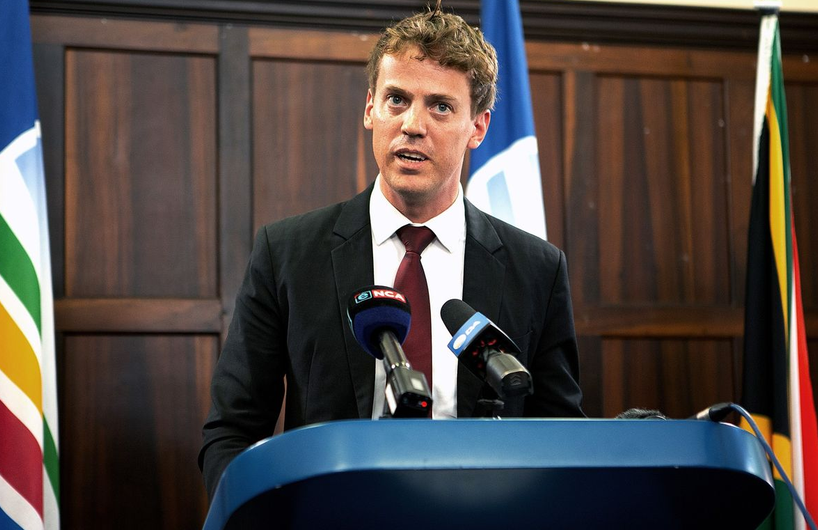
DA federal finance chief Mark Burke has defended his role in a cryptocurrency company at the centre of an ongoing South African Reserve Bank investigation, while insisting he will remain in his influential position inside the party.
Burke’s position has come under renewed scrutiny after Kastelo, a fintech company he co-founded with his brother, became involved in a dispute with the Reserve Bank over cryptocurrency transactions and foreign-exchange rules.
The Johannesburg High Court dismissed Kastelo’s application to review and set aside a Reserve Bank blocking order, leaving funds in one of the company’s bank accounts frozen while the investigation continues.
The court’s judgment did not find that Burke or Kastelo had committed a contravention. It found that the Reserve Bank had reasonable grounds to suspect that exchange-control rules may have been breached at the stage when the blocking order was issued.
That distinction has become central to the political argument around Burke.
The DA has removed him from Parliament’s finance committee and related finance-cluster responsibilities, and he is no longer the party’s finance spokesperson. However, Burke has refused to give up his position as the DA’s federal finance chair.
He has also rejected suggestions that the court ruling amounts to a finding of wrongdoing against him personally.
Burke Defends Cryptocurrency Transactions
Kastelo’s dealings involved moving money offshore through cryptocurrency trades. The Reserve Bank investigation has focused on whether the company’s business model complied with South Africa’s exchange-control framework.
The court record refers to a suspicion involving at least R4 billion in foreign-currency transfers. That figure relates to the scale of the transactions under investigation and should not be confused with the amount covered by the specific blocking order.
The blocking order applied to approximately R13 million held in a Kastelo account at the time.
Burke has argued that the money was not permanently removed from South Africa because the company bought cryptocurrency offshore and expected value to return in another form.
Although people were entitled to have an emotional response to the amount involved, he said, the transactions should be understood in the context of importing value rather than permanently exporting money.
“The amount of money involved is not an amount that has been somehow syphoned out of the country forever.
“In fact, it’s the exact opposite. Any business looking to import something is doing so because they hope to attain a lower price for that purchase in a foreign place and then to sell it for a higher price locally. And so value would leave in one form, being the currency payment for that good, and it would return in another form being the good being sold here. And in this case, the good that was purchased was cryptocurrency, either Bitcoin or stablecoin,” he said.
Burke’s explanation is his defence of the business model. It is not a final legal finding on whether the model complied with the Exchange Control Regulations.
The Reserve Bank has not completed its investigation, and the court did not decide the broader regulatory question in Kastelo’s favour or against it.
What The High Court Decided
The High Court’s decision concerned the Reserve Bank’s power to issue a temporary blocking order while it investigated suspected exchange-control contraventions.
Kastelo challenged the order and argued that the process was unlawful, procedurally unfair and based on incorrect information.
The court rejected the application and found that the Reserve Bank had reasonable grounds for its suspicion.
The judgment said the threshold at that stage was not proof of a completed contravention. The Reserve Bank needed to show reasonable grounds for suspecting that the regulations may have been breached.
The court said that information from the bank, clients, whistle-blowers and the Reserve Bank’s own investigation had to be assessed cumulatively and objectively.
It also found that the blocking order was temporary and preservatory. Its purpose was to prevent the possible dissipation of funds while the investigation continued.
The order did not amount to a final forfeiture of the money and did not establish that Kastelo had committed a crime.
A later decision to forfeit funds would require a further process in which Kastelo would be entitled to be heard.
The Reserve Bank has up to 36 months from the date of the blocking order to complete its investigation.
Burke Says He Is Not Personally Under Investigation
Burke has maintained that he is not personally being investigated and that the High Court judgment made no finding of misconduct against him.
He has also said that he took steps to avoid any conflict of interest after entering Parliament, including informing the party and parliamentary officials that he should not participate in matters involving the Reserve Bank.
His position is that his political responsibilities and his former business interests can be separated through recusal and disclosure.
The decision to remove him from the parliamentary finance committee was presented by the DA as a precaution designed to avoid perceptions of a conflict of interest while the Reserve Bank inquiry remains open.
That decision does not amount to a finding that Burke is guilty of wrongdoing.
The DA has said it supports due process and will not prejudge the outcome of an investigation by an independent State institution.
At the same time, the party has acted to limit Burke’s role in the parliamentary structures most closely connected to financial oversight.
‘I Am Not Going Anywhere’
Burke has drawn a line between his parliamentary committee positions and his role inside the DA.
He said he intended to remain the party’s federal finance chair and would continue helping the DA prepare for the local government elections.
Burke said he was “not going anywhere”.
“I will throw my weight behind the DA and getting this election done and making sure that we deliver a bigger vote share than we ever have. And I’ll continue trying to manage the party’s finance as well.”
His decision to retain the position means the political dispute is not over.
The federal finance chair is responsible for a sensitive area of party administration, especially during an election period when parties need to raise funds, comply with political-finance rules and present themselves as credible managers of public resources.
The controversy has therefore raised questions about whether Burke’s continued internal role could affect public confidence in the DA’s message on accountability.
The party’s position is that a precautionary removal from parliamentary finance structures can coexist with his continued internal leadership role because there has been no final finding against him.
DA Leadership Under Pressure
The dispute has also exposed divisions within the DA over how the party should respond.
According to party insiders, some leaders initially believed Burke should be defended because no competent authority had found that he or Kastelo had committed wrongdoing.
“People were saying we cannot throw Mark under the bus when there is no finding against him,” one source said.
Other senior figures reportedly argued that the party needed to act before the controversy damaged its credibility on financial accountability.
“Once this became a question about trust and perception, the calculation changed,” another source said.
The internal disagreement became more visible after DA leader Geordin Hill-Lewis publicly supported Burke, according to the supplied account.
One source claimed that Hill-Lewis’s support deepened the split between officials who wanted Burke protected and those who believed action was necessary.
“After Geordin threw his support behind Mark, with some of the officials siding with him, things got messy on the other side as some top leaders pushed back and demanded action against the federal chairperson,” the source said.
“Geordin was told that he had missed the mark by shielding Mark over his involvement in the R4-billion scandal. Two camps in the DA leadership, with one siding with Geordin to shield Mark and the other faction demanding action, had a go at each other.”
These internal claims have been attributed to party sources and have not been independently confirmed in the supplied material.
The DA did not provide a detailed public response to the alleged leadership split.
Why The Reserve Bank Inquiry Matters
The investigation matters because exchange-control rules govern how money moves across South Africa’s borders and how foreign currency may be obtained and used.
The Reserve Bank’s concern, as reflected in the court record, was not simply the purchase of cryptocurrency.
It examined whether clients’ foreign-exchange allowances were being used in a way that benefited the company, whether clients fully understood the transactions conducted in their names and whether the model complied with the rules governing foreign investment and discretionary allowances.
Kastelo has maintained that its clients gave the company mandates to conduct trades and that the resulting value was returned to South Africa in rand.
The court did not finally decide whether that model is lawful.
Instead, it found that the evidence before the Reserve Bank was sufficient to justify the temporary blocking order while the investigation continued.
That means the regulatory dispute remains unresolved.
A finding that there were reasonable grounds for suspicion is not the same as a finding that the suspected contraventions have been proven.
The difference is important for both the company and Burke.
Kastelo still has the opportunity to answer the allegations during the investigation and any later process.
Burke remains entitled to the presumption that he has not committed wrongdoing unless a competent authority or court establishes otherwise.
Committee Removal And Political Optics
Burke’s removal from the Standing Committee on Finance and his alternate role on the Standing Committee on Appropriations reflects the sensitivity of the matter.
Those committees deal with public finances, taxation, spending and oversight of key institutions.
A member linked to a company being investigated by the Reserve Bank could face questions about perceived conflicts, even if he recuses himself from specific matters.
The DA’s decision appears to have been intended to reduce that risk.
It also gives the party room to argue that it is acting responsibly without declaring Burke guilty before the investigation is complete.
The political challenge is that the precautionary move can be read in two different ways.
Supporters may see it as evidence that the DA is protecting the integrity of Parliament’s oversight work.
Critics may argue that the decision came only after the controversy became politically damaging and that Burke should also have stepped aside as the party’s finance chief.
That tension is likely to remain central as the local government election campaign develops.
Burke’s Future In The DA
Burke’s refusal to relinquish the federal finance chair role means the party must continue managing two competing messages.
It must defend the principle that allegations should not be treated as proof, while also convincing voters that it takes financial accountability seriously.
Burke, for his part, says he will continue to support the party and work to increase its vote share.
He has framed the dispute as a regulatory matter involving a company whose business model has not been finally ruled unlawful.
The Reserve Bank’s position is that the investigation and the blocking order were justified by reasonable grounds for suspicion.
The High Court has upheld the blocking order at that stage of the process, but it has not pronounced Burke or Kastelo guilty.
The outcome of the Reserve Bank investigation may therefore have consequences beyond the company’s frozen account.
It could influence whether additional action is taken against Kastelo, whether any funds are forfeited, whether the company challenges future decisions and how the DA handles Burke’s political role.
What Happens Next?
The Reserve Bank investigation is continuing.
Kastelo may still engage with the regulator, challenge later decisions or pursue further legal remedies.
Any future forfeiture process would be separate from the temporary blocking order and would give the company an opportunity to make representations.
For the DA, the immediate question is whether Burke can remain federal finance chair without the controversy becoming a larger election liability.
The party has already removed him from sensitive parliamentary finance roles, but Burke says he will continue managing the party’s finances and campaigning for a stronger vote.
The allegations against Kastelo have not been finally proven, and Burke has not been found guilty of any offence.
But the investigation, the court ruling and the political reaction have placed his role under intense scrutiny.
The dispute is now as much about public trust and political accountability as it is about the technical rules governing cryptocurrency and offshore transactions.