

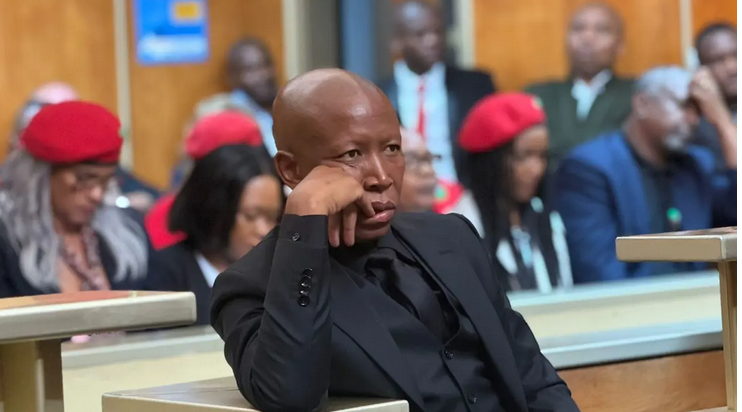
EFF leader Julius Malema has promised that SASSA beneficiaries would receive free basic municipal services, including water and electricity, if his party is given the opportunity to govern.
Malema also said children from poor households should not have to pay registration fees at universities and other higher-education institutions.
He made the remarks while addressing the EFF Ground Forces Forum in uMsunduzi, Pietermaritzburg, as the party campaigns ahead of the 2026 Local Government Elections.
South Africans are due to vote in the local-government elections on Wednesday, November 4.
Malema presented the proposals as part of the EFF’s approach to tackling poverty, unaffordable electricity and barriers to education.
He argued that basic services should be treated as rights rather than ordinary commercial products for households that cannot afford them.
The EFF leader also proposed linking government systems so that municipalities could identify SASSA beneficiaries automatically and exempt qualifying households from paying for water and electricity.
His comments are campaign promises and would require detailed policy, funding and administrative plans if the party were to implement them.
Malema Targets Electricity Costs
Malema criticised the cost of electricity and questioned whether Eskom should be focused on making profits.
He argued that electricity should be affordable for households and that the power utility’s role should be to generate enough money to sustain its operations rather than maximise profit.
“Why should electricity be so expensive? Why should Eskom make a profit? We don't want Eskom to make a profit because giving people electricity is not a business. It's a basic right. Profit must be made by companies,” he said.
“We are not about making a profit. As long as they generate enough money to sustain themselves, that is enough. Then give our people affordable electricity.”
Malema’s argument places the price of electricity at the centre of the EFF’s local-government campaign.
The party has often connected the cost of services to broader questions of inequality and economic access.
In Pietermaritzburg, he said high prices meant that many households with electricity infrastructure were still unable to use it regularly.
That distinction is important in communities where homes may have cables, plugs and connections but families cannot afford monthly bills or prepaid electricity.
‘Cables Are Not Electricity’
Malema described unaffordable electricity as a form of exclusion.
He compared the situation with racial exclusion during apartheid, arguing that the mechanism had changed from denying black people access to electricity to making electricity too expensive for many households to use.
“You know, racism works in a different way. In the past, they didn't give us electricity because we're black. They were like, what do they do with electricity? We don't give them electricity.
“Today, because we've got rights and they can't exclude us as blacks, they use money to exclude us. That gives them electricity, but makes it more expensive so that they cannot have electricity. The same thing of apartheid is happening today.”
He said the problem was visible inside homes where electrical infrastructure existed but did not translate into a reliable supply for residents.
“And today is even worse because inside your house, you've got cables. Those cables are not electricity. It's just cables.
“You've got a plug on the wall. It's so painful because when you switch it on, the light doesn't come on because you cannot afford it.”
The remarks reflect a political argument that access to electricity must be measured not only by whether a connection exists, but also by whether a household can afford to use it.
SASSA Beneficiaries And Automatic Exemptions
Malema said an EFF-led government would use information already held by government to identify people who qualify for free services.
He argued that residents receiving social grants should not have to repeatedly explain their financial circumstances to municipal officials.
Under his proposal, a person’s SASSA status would automatically alert a municipality that the household required assistance.
“In the EFF, everybody who's on SASSA, the only place where you're going to tell people you're poor is at SASSA. From there, you don't tell anyone if you're poor or not,” he said.
“We must take you to SASSA. Once we find you at SASSA, we know this woman is poor. Therefore, we must give her free electricity.”
Malema said it was unfair for government systems to recognise a person as poor when they applied for assistance, only to treat them as able to pay when the electricity account arrived.
“They can't say to you, you are poor during a day of SASSA. And on the day of paying electricity, you are no longer poor, you must pay.”
He said departments should share information so that residents would not have to apply separately for relief at every municipality.
“This is one government. So that when they punch your ID, it must already tell them this is a SASSA beneficiary,” he said.
“Then automatically, they exclude you from paying for water and electricity because you are poor. So you shouldn't go to some neighbour of yours there at the municipality and be saying to a neighbour, 'Hey, I'm poor. I don't have anything. Look at me.'”
The proposal would require government systems to share information accurately and securely.
It would also require clear rules about which SASSA beneficiaries qualify, whether the exemption would apply to all members of a household and how municipalities would replace the revenue normally received from service charges.
Malema did not provide a detailed funding model during the address.
Comparing Services With No-Fee Schools
Malema compared the proposed electricity and water exemptions with the existing system of no-fee schools.
He argued that government already identifies poor communities for education support and should use similar information to assist families with basic municipal services.
“Just by punching your ID (Identity card), look at what they do to our children. They take them to no-fee schools. They say this area is a no-fee school, meaning in this area, the people are poor here. They can't pay school fees.”
He questioned why a family could be recognised as poor enough to qualify for a no-fee school but still be expected to pay for electricity and water.
“Why do you say they are poor when it comes to school, but when it comes to electricity, they are rich, they must pay?” he asked.
Malema said households in areas with no-fee schools should automatically qualify for free basic municipal services until their circumstances improved.
“Then we automatically exclude them from paying for water and electricity until such time that you create jobs for their children and give these children money to go and pay for water and electricity.”
The proposal links social assistance, education policy and municipal services into a single support system.
However, the criteria used to determine eligibility for no-fee schooling are not necessarily identical to the criteria used for SASSA grants or municipal indigent registers.
Any new policy would therefore need to explain how the systems would be aligned and how mistakes or changes in household circumstances would be managed.
Higher Education Fees Under Attack
Malema also criticised registration fees charged by universities and other higher-education institutions.
He argued that students from households identified as poor should not be expected to find large upfront payments before they can begin their studies.
The EFF leader said the problem was especially serious for students who attended no-fee schools and relied on school meals or other forms of assistance.
“After going to a no-fee school, after they give you food at school, when you go to the university, they say to you, give us registration fee. How do you say throughout my years, I'm poor, I've been going to a no-fee school. When I come here, you say I must pay a registration fee. Where do I get that money?”
He said the policy should cover both registration fees and tuition fees for children of SASSA beneficiaries.
“There shouldn't be fees at all for children of the beneficiaries of SASSA. For children who come from no-fee schools, automatically their qualifications must enter them into the university. Throughout their school years, you have been saying they are poor, you have been giving them education,” he said.
Malema also argued that students from no-fee schools should automatically qualify for admission to higher education.
That proposal would represent a significant change to current admissions systems, which generally consider academic requirements, programme capacity and institutional rules.
The EFF would need to provide further detail on how automatic admission would operate, especially where there are limited places or programmes with specific entry requirements.
Election Campaign Context
Malema’s promises come as parties prepare for the local-government elections on November 4.
Municipal elections determine the councils responsible for local services such as water distribution, electricity billing, refuse removal, roads and community facilities.
Although national and provincial government control important parts of social assistance and higher education, municipalities play a major role in billing households and administering indigent relief.
That makes service affordability a central issue in local elections.
The Electoral Commission has formally set November 4 as Election Day and has begun the timetable leading up to the poll.
The EFF is using its campaign events to present a direct message to low-income households: social grants, basic services and access to education should be linked through one government system.
Malema told supporters that the party would be able to address the challenges facing the country, including high electricity prices.
The promises are likely to appeal to households dealing with unemployment, rising living costs and service disconnections.
They may also prompt questions about how municipalities would fund free services while maintaining electricity networks, water infrastructure and other public systems.
Funding And Implementation Questions
Making water and electricity free for SASSA beneficiaries would have financial consequences for municipalities and service providers.
Municipalities currently rely on a mixture of grants, rates and service charges to fund operations and infrastructure.
A policy that removes charges for a large group of households would need to identify a replacement source of funding or reduce the cost of providing the services.
It would also need to address households that are poor but do not receive SASSA grants, as well as people whose circumstances change after they qualify.
There would be practical questions about prepaid meters, existing debt, illegal connections and households that include both grant beneficiaries and people earning an income.
Malema’s speech focused on the principle of automatic assistance rather than these implementation details.
Those details would be important if the promises were included in a formal election manifesto or a municipal governing programme.
The use of linked government systems would also require protections for personal information.
Officials would need to ensure that only authorised people could access SASSA and identity information and that the data was accurate.
The proposal could reduce the burden on poor residents who currently have to apply for relief more than once, but it would need safeguards to prevent errors, exclusion or misuse of personal information.
EFF’s Message To Poor Households
Malema’s central message was that poverty should be recognised consistently across government.
He argued that a person should not be treated as poor when seeking a grant, a school place or school meals, but then be treated as able to pay full charges for electricity and water.
The EFF’s proposed system would use a person’s existing relationship with SASSA to trigger automatic municipal assistance.
The party also wants higher-education costs to be linked to a student’s school and household background.
This would shift the focus from individual applications to automatic eligibility based on government records.
Supporters may see that as a way to reduce red tape and protect people from humiliating means tests.
Critics may ask whether SASSA status alone is enough to determine a household’s ability to pay, particularly when a family’s income, size and living arrangements differ.
The debate is likely to continue during the election campaign.
What Happens Next?
The EFF is expected to campaign on these proposals as the November 4 local-government election approaches.
The party would need to set out the details in its manifesto, including eligibility, funding, administration and the role of national government in supporting municipalities.
Voters will also be able to compare the EFF’s promises with the plans of other political parties.
For now, Malema’s message is clear: SASSA beneficiaries should not pay for basic water and electricity, and poor students should not be blocked from higher education by registration or tuition fees.
The proposals place affordability, poverty and access to services at the centre of the EFF’s campaign.
Whether they can be implemented, how much they would cost and how they would affect municipalities will depend on the party’s detailed policy and its ability to secure political control and administrative support.