

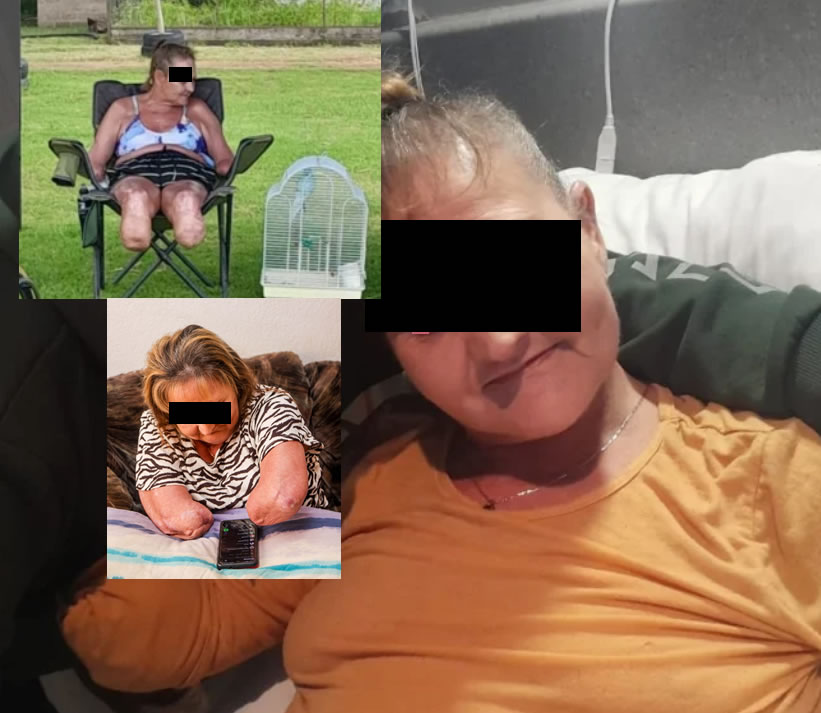
Mechell Pieterse still feels pain in her big toe — a stubbed-toe sensation so convincing that she sometimes forgets her lower legs are no longer there.
Neither are her hands. Large parts of her memory have also disappeared in a blur of pain, fever and hospital treatment.
The Springs woman struggles to recall the exact sequence of events that changed her life, although her daughter, Rachel, 24, has helped her piece the timeline together.
Septic shock, cardiac arrest and a quadruple amputation eventually robbed Mechell of all four limbs, but the amputations also saved her life.
“It’s difficult to revisit the story,” Mechell says.
Before the medical crisis, Mechell had lived a full and active life. In her youth, she did modelling jobs before working in administration at her father’s engineering company.
That was where she met her husband, Piet, who was one of the employees.
The couple will celebrate their 18th wedding anniversary in December. Piet, now a clerk of works at Impala mine, has remained at his wife’s side through the ordeal, keeping the vows they made to each other through sickness and health.
He was there in December 2024 when the crisis began.
Loadshedding was in full swing when Mechell tripped over a loose mat in the dark house. She fell onto her knees and, although she was in pain, did not believe she had suffered a serious injury.
She went to bed.
The next morning, Piet saw that his wife’s leg was badly swollen and called an ambulance.
“Mom only went to hospital then because she didn’t think it was broken at first,” Rachel says.
At an East Rand hospital, doctors inserted a pin and screws into the broken leg as internal fixation.
“That’s where the problems started,” Mechell says. “It never healed properly.”
For almost six months after the operation, Mechell moved around on crutches or with a walking frame.
She attended physiotherapy, but the treatment did not resolve the discomfort and pain. She remained unable to walk normally on the injured leg.
Then the leg began twisting, almost as if it wanted to break underneath her, Rachel recalls.
“The physio said we needed to see a doctor.”
A medical examination showed tissue damage in the leg, with bleeding where the pins and screws had been placed.
Doctors told the family that Mechell needed another operation, and a date was set.
But before the scheduled surgery could take place, Mechell’s condition deteriorated rapidly.
On the morning of 27 May 2025, Rachel noticed that her mother looked pale. Piet had already left for work.
“It looked like she couldn’t breathe. She tried to stand up, but she couldn’t put any weight on the leg at all,” Rachel says.
Mechell was clammy and sweating. As Rachel helped her get dressed, she noticed lumps on the injured leg.
“They looked like sores that hadn’t burst yet.”
Rachel phoned her father, who called an ambulance. What followed was a medical emergency that the family still finds difficult to describe.
Mechell’s heart stopped three times. She was placed in a coma and transferred to another hospital, where she remained unconscious for a week.
Her kidneys failed and she needed dialysis. Her heart also weakened.
Then Rachel and Piet noticed that Mechell’s fingers had turned black.
Doctors diagnosed sepsis and septic shock.
Sepsis is a life-threatening response to an infection that can cause widespread organ damage. In severe cases, reduced blood flow and tissue damage can affect the extremities, sometimes making amputation necessary to prevent the infection and tissue death from spreading further.
Doctors discovered that the internal fixation in Mechell’s leg had failed. According to the family’s account, the pins and screws had worked loose inside the leg, damaging tissue and causing internal bleeding that went undetected for months.
The pooled blood and damaged tissue became infected. The infection then spread through her bloodstream, triggering sepsis.
By the time it was identified, the infection had already begun destroying tissue in Mechell’s hands and feet. That explained why her fingers had turned black and why her circulation was so severely affected.
By the middle of June 2025, doctors told the Pieterse family that the damage to her hands and feet was so extensive that amputation was necessary.
“My left hand was first, and later that week they cut off my right hand and both legs,” Mechell says.
The family had initially hoped that only her fingers would need to be removed. But the extent of the damage changed the decision.
“They said at first it might just be the fingers, but then it was everything,” Mechell says.
When the amputations were complete, Mechell did not know how to feel.
“I wasn’t shocked or angry – I think I was just grateful to be alive. My husband and I talked about it beforehand and decided they should amputate, as long as I can live. It was something that just had to be done.”
Four days after her final amputation, Mechell was admitted to a care facility.
There, she received counselling while Rachel was trained to care for her mother.
Mechell had to learn how to eat and write again. She now uses special Lycra sleeves over her stumps, with attachments that allow her to use a knife, fork and pen.
The process has demanded patience from the entire family. Everyday tasks that once happened without thought now require planning, equipment and physical assistance.
Mechell was finally discharged on 22 August 2025 and began learning how to adapt to life at home.
A wheelchair allows her to move around the house, but Rachel and Piet still have to lift her out of bed in the mornings, into the car and onto a chair in the bath.
The family has had to create new routines around her care while also helping Mechell maintain her independence wherever possible.
She has taught herself to play computer games to fill the empty days.

“That’s what I do every day. I love Plants vs. Zombies, FarmVille and lots of other farm games,” she says.
The games offer a distraction, but there are parts of her old life that Mechell misses deeply.
She misses being able to play with her pets and going fishing with her family.
The family has tried to keep fishing within reach. They cast a line into the water for her, hoping she will eventually be able to reel in a catch herself.
“We cast a fishing line into the water for her, but we haven’t caught a fish yet to see if she can reel it in,” Rachel says with a smile.
Mechell has had measurements taken for leg prostheses, but the design process is still under way. The family does not yet know the final cost.
She also hopes to receive hand prostheses in future.

Prosthetic devices and rehabilitation could give her greater independence, but the process can be lengthy and expensive. It may involve repeated measurements, fittings, training and adjustments as the body adapts.
For now, Mechell continues to deal with phantom pain.
Phantom sensations and phantom pain are common after amputation. The nervous system can continue to interpret signals as coming from a limb that is no longer present.
For Mechell, the sensation is especially strong in the toes that she lost.
“It often feels like I’ve stubbed a big toe, and it itches too,” she says.
The pain can be confusing and frustrating, but it has not taken away her determination.
“But I try to stay positive, and I’d really like to stand and walk again.”
That ambition now shapes the family’s hopes for the future.
For the moment, she waits while prosthesis designs are considered and the practical details of rehabilitation are worked out.
She fills the empty days with computer games and thoughts of future fishing trips.
Rachel and Piet remain central to her recovery, helping with physical care while encouraging her to do as much as she can for herself.
The journey has already taken Mechell through septic shock, three cardiac arrests, a coma, kidney failure, dialysis and the loss of both hands and both legs.
She survived because the amputations stopped the destruction caused by the infection.

Now she faces a different kind of challenge: learning how to live, move and dream in a body that has changed beyond recognition.
Walking again may require years of rehabilitation, specialised equipment and continued support.
But after everything she has survived, Mechell believes it is possible.
“She’s already survived septic shock, cardiac arrest and quadruple amputation,” Rachel says. “Walking again seems possible by comparison.”