

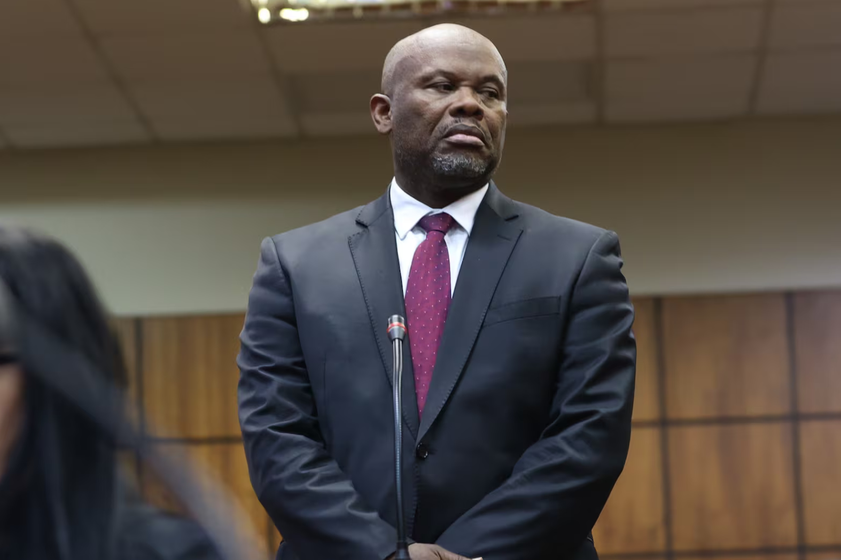
The bail hearing of suspended deputy national police commissioner Shadrack Sibiya is set to continue on Wednesday, with the state expected to press its case for his continued detention after recordings allegedly captured him threatening the father of a 16-year-old girl.
In one of the recordings played in court, Sibiya is allegedly heard saying he “can deal with him very quickly and easily”.
The state is relying on the recordings as it opposes bail for Sibiya, who faces charges including rape, sexual grooming of a child and human trafficking.
A further charge of negligent possession of a firearm has also been added to the case.
The recordings were played during the cross-examination of Detective Nokukhanya Ndlovu, an investigating officer attached to the Commission Recommendations Task Team.
The first recording allegedly captured Sibiya speaking to the father of the 16-year-old girl. He is heard expressing disappointment with the man and reminding him of financial assistance he had provided in the past.
The alleged support included payments ranging from R4,000 to R10,000 on different occasions, as well as the use of Sibiya’s bank card to buy groceries.
“I took you like my younger brother,” Sibiya is heard saying.
He allegedly accused the man of speaking badly about him and telling other people to have him arrested, despite Sibiya remaining close to him and continuing to support him.
“But in turn, you were saying bad things about me, and you even told them to arrest me. You did me so many wrong things, while I was still close to you,” he said.
The recording then allegedly became more threatening.
“The easiest person to deal with is you. I can deal with you very quickly and easily,” Sibiya is heard saying.
He allegedly added that he had not acted against the man, even though he knew what the man had supposedly been saying about him.
The state says the recording is relevant to the bail application because it may indicate a risk of witness intimidation or interference with people connected to the case.
Sibiya’s legal team said it would deal with the recordings later and described them as new evidence.
A second recording was also played in court. In that recording, a caller appears to say that they had been approached by a South African Police Service officer who allegedly wanted them to work with the girl’s father to influence the outcome of Sibiya’s case in exchange for a bribe.
The recording was unclear, prompting Magistrate Hleziphi Mkhasibe to order that proper translations be prepared.
The translations are expected to be provided on Wednesday, when the bail proceedings resume.
The court will need to consider the meaning of the recording, the identity of the people speaking and whether the evidence can reliably be linked to Sibiya or anyone acting on his behalf.
The dispute over the girl’s father also featured during cross-examination.
Sibiya’s lawyer, Amanda Nel, put it to Ndlovu that the father of the 16-year-old girl was allegedly in a relationship with another teenage girl involved in the case.
Ndlovu said she had no knowledge of the alleged relationship.
Nel insisted that one of the girls was the girlfriend of Sibiya’s associate.
Ndlovu said she had interviewed a witness about the issue but declined to reveal the person’s identity.
“Your Worship, I don’t think that it’s fair for the defence to ask me a name to divulge a witness that I’ve interviewed,” she said.
Ndlovu said the names of witnesses had been recorded using alphabetical identifiers.
Nel maintained that one of the girls was the associate’s girlfriend.
Ndlovu said one of the girls was a friend of the associate’s daughter and that the other girls were also friends.
She agreed with Nel that the three girls knew one another.
The defence also challenged Ndlovu’s description of The Grand, the Sandton venue where Sibiya was arrested.
Nel argued that the venue was not strictly a strip club and that Sibiya had been arrested in the restaurant area while in the company of three adult men.
Ndlovu disagreed, saying the venue had a strip club at the entrance, with a hotel and restaurant behind and alongside it.
“The point where I entered is a strip club and the point where I found the applicant is at the strip club,” she told the court.
Ndlovu said the girls were seated in the strip-club section on the night of 15 May.
Nel asked whether Ndlovu had direct evidence from any of the complainants that they had been taken into the strip club rather than the restaurant.
“I have direct evidence from the complainants that they were taken to the strip,” Ndlovu said.
She alleged that the girls were taken through the strip-club area to a VIP lounge, where they ate and drank.
Ndlovu further alleged that Sibiya instructed the girls to say they were celebrating one of their birthdays to gain entry because they were under 21.
According to Ndlovu, Sibiya spoke to the manager, which allowed the girls to enter.
Nel argued that this meant the state’s version had expanded to allege that Sibiya deceived the owner or manager of the venue, whom he knew.
Ndlovu confirmed that this allegedly happened in the presence of the girls and that one of Sibiya’s associates was also present.
The court also heard evidence about what happened before the alleged rape.
Ndlovu said the girls had planned an outing in May and that Sibiya became involved in arranging transport for the group.
She said he suggested that they go to The Grand, a venue owned by a friend of his.
The defence disputes parts of this account and maintains that Sibiya’s associate was also involved in arranging the outing.
According to Ndlovu, Sibiya met the group at their hotel and instructed them to change their clothes before taking them to the venue.
She said the girls were uncomfortable with his strict behaviour and initially did not know who he was.
At The Grand, Sibiya allegedly appeared to be known at the venue and instructed the girls to say they were celebrating a birthday.
Ndlovu said he paid for their food and drinks.
The group later returned to the hotel, where Sibiya allegedly entered their room carrying liquor hidden under his jacket.
The defence has disputed how Sibiya was introduced to the girls.
His legal team said he was not introduced as “General Sibiya”, but by the name Sotobe.
The defence said the girls only learnt later that he was a police officer after his associate allegedly identified him as such.
Ndlovu maintained that Sibiya was an adult, while the defence insisted that he was never introduced to the girls as a police officer.
Sibiya, 59, was arrested following an investigation by the Commission Recommendations Task Team, which is examining matters arising from the Madlanga Commission.
He has denied the allegations.
The state alleges that Sibiya raped an 18-year-old woman at a Sandton hotel on 15 May after she was allegedly given alcohol and lost consciousness.
He is also accused of sexually grooming a 16-year-old girl through WhatsApp between July and August, including allegedly possessing and sharing sexually explicit images of her.
The state further alleges that he trafficked three people for sexual exploitation.
The prosecution maintains that it has a strong case against Sibiya and is opposing his release on bail.
Sibiya remains in solitary confinement at the C-Max facility at Kgosi Mampuru II.
His legal team has argued that the conditions of his detention lack a justifiable basis.
Ndlovu said the arrangements were necessary for security reasons and that the conditions were appropriate.
The defence said the detention issue should be dealt with by the Department of Correctional Services.
The additional firearm charge is also expected to form part of the wider bail argument. The state alleges that a firearm found in Sibiya’s vehicle was not stored in a safe, leading to a charge of negligent possession or storage under firearms legislation.
The defence has questioned why the firearm allegation was raised after the weapon was allegedly seized on the day of Sibiya’s arrest.
The bail hearing is not a trial, and the recordings and other evidence have not yet been finally tested.
Sibiya remains presumed innocent unless convicted. The state will ultimately have to prove the criminal charges beyond reasonable doubt, while the defence will have the opportunity to challenge the evidence and present its own case.
For now, the recordings have strengthened the prosecution’s argument that Sibiya could pose a risk to witnesses or interfere with the investigation if released.
The court is expected to hear the translations of the unclear recording and further arguments from the state and defence when the bail hearing continues on Wednesday.
Until Magistrate Mkhasibe delivers a ruling, Sibiya will remain in custody at C-Max as the court considers the allegations, the evidence and the conditions under which he could potentially be released.